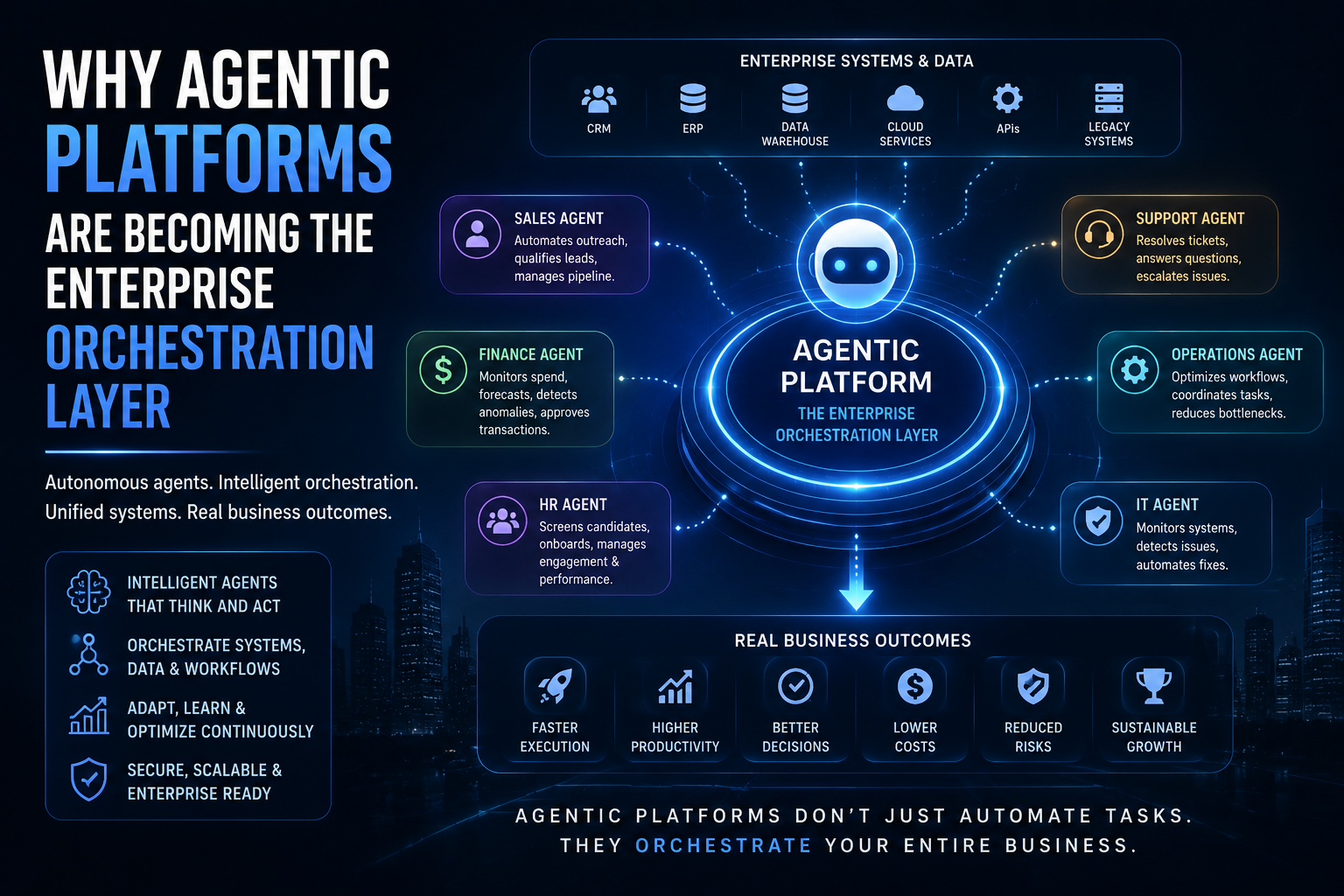
Why agentic platforms are becoming the enterprise orchestration layer
Enterprise software is entering a new phase. For years, AI was mostly added as a feature inside point tools: a copilot in a CRM, a summarizer in email, or a chatbot layered onto support workflows. That model created local productivity gains, but it did not solve the bigger enterprise challenge: coordinating work across systems, policies, data, and teams. That is why agentic platforms are increasingly being positioned as the orchestration layer for modern businesses.
The shift matters for founders and operators because scaling rarely fails from a lack of tools. It fails when systems do not coordinate. As AI agents become capable of reasoning, taking actions, and collaborating across applications, the strategic value moves to the layer that governs execution. That orchestration layer is where companies connect automation, approval logic, business context, and measurable outcomes.
From point solutions to agentic ecosystems
One of the clearest reasons agentic platforms are rising is that enterprises are moving beyond isolated assistants. Gartner says AI agents will evolve from task- and app-specific helpers into “agentic ecosystems,” changing enterprise applications into platforms for seamless autonomous collaboration and dynamic workflow orchestration. In practical terms, this means businesses no longer want ten separate AI features. They want coordinated systems that can move work across departments and tools.
This is a major architectural shift. A point tool can draft an email or summarize a meeting, but an orchestration layer can take a customer request, interpret intent, pull data from multiple systems, route approvals, trigger downstream actions, and log everything for auditability. The difference is not just intelligence. It is business execution. That is why the enterprise conversation is moving from AI features to agent-native operating models.
For small business leaders and founders, this trend mirrors a familiar systems principle: isolated optimizations create complexity, while integrated systems create scale. Agentic platforms are winning attention because they promise to unify workflows rather than fragment them further. As organizations adopt more AI, orchestration becomes the mechanism that keeps automation aligned with how the business actually runs.
Adoption curves are forcing strategic decisions now
The market is not moving slowly. Gartner predicts that 40% of enterprise applications will feature task-specific AI agents by the end of 2026, up from less than 5% in 2025. That kind of adoption curve changes the strategic timeline for software vendors and enterprise operators alike. What looks experimental today is quickly becoming baseline capability.
Gartner also warns that software executives have only a three- to six-month window to define their agentic AI strategy or risk falling behind competitors. That urgency exists because once orchestration patterns become embedded in enterprise stacks, late adopters will not just be behind on features. They will be behind on workflow design, operational data, governance models, and cross-functional execution habits.
For business leaders, the takeaway is practical. Waiting for the market to fully mature may feel prudent, but in fast platform transitions, delayed decisions create higher switching costs later. The companies that define their orchestration layer early gain a stronger foundation for workflow automation, operational efficiency, and scalable growth. They are not merely buying AI. They are designing the control system for how work gets done.
The value is shifting to the control plane
Another reason agentic platforms are becoming the enterprise orchestration layer is economic. Gartner’s 2025 research says agentic orchestration could redirect $550 billion in global software and services spend by 2029. That is a powerful signal that the value pool is moving away from standalone intelligence and toward the control plane that coordinates action.
In business terms, the winning layer is not just the one that generates answers. It is the one that decides what happens next, under what rules, in which system, with what visibility, and toward which KPI. That is why orchestration has become strategically important. It determines whether AI creates reliable throughput or simply produces more activity.
This distinction matters especially for scaling companies. A founder can get quick wins from individual AI tools, but durable enterprise value comes from systems that connect revenue operations, finance, support, delivery, and compliance. The orchestration layer sits at that intersection. It turns scattered capabilities into a business system that can be measured, improved, and trusted.
Enterprise vendors are re-architecting around orchestration
The biggest software companies are signaling where the market is ed. McKinsey notes that Microsoft is embedding agents into Dynamics 365 and Microsoft 365 through Copilot Studio, Salesforce is expanding Agentforce into a multiagent orchestration layer, and SAP is rearchitecting BTP for agent integration through Joule. These are not minor feature updates. They are platform-level moves.
When incumbent vendors redesign around orchestration, it usually means the architectural center of gravity has shifted. Enterprises no longer want AI only at the user interface. They want agentic capabilities integrated into the workflow backbone of the business. That includes process coordination, cross-system execution, and governed autonomy at scale.
McKinsey goes further by describing the “agentic AI mesh” as the connective and orchestration layer that enables large-scale agent ecosystems to operate safely and efficiently. That language is important because it frames orchestration as infrastructure, not enhancement. The businesses that understand this early can make better platform decisions and avoid building fragile automation stacks that cannot scale beyond a few pilots.
Scaling is hard, and orchestration solves the real bottleneck
Many companies have already learned that deploying AI is easier than scaling it. McKinsey reports that fewer than 10% of use cases deployed ever make it past the pilot stage. It also says that while enterprise AI investment is still growing, nearly two-thirds of organizations have not yet begun scaling AI across the enterprise. The constraint is no longer excitement. It is operationalization.
This is where agentic platforms become critical. An orchestration layer helps standardize how agents access data, how they hand off tasks, how they request approvals, and how outcomes are monitored. Without that layer, each AI initiative becomes a custom project. That drives up complexity, increases governance risk, and makes it difficult to prove business value.
For operators building scalable businesses, this is a familiar pattern. Growth stalls when every process depends on exceptions, manual oversight, or undocumented logic. Agentic orchestration addresses that by creating repeatable execution patterns. It is less about adding more intelligence and more about building a reliable business system around intelligence.
Trust, policy, and execution now live in the same layer
One of the strongest reasons orchestration is becoming central is that enterprises need governed execution, not ad hoc automation. OpenAI’s 2026 enterprise case studies describe systems using a governed execution layer and a governed orchestration pipeline to keep model-driven actions predictable in production. This reflects what enterprise buyers increasingly expect: not just AI output, but controlled AI action.
OpenAI’s enterprise updates repeatedly emphasize approval gates, role-based access control, customizable policies, sandboxing, and auditable governance as core capabilities for agentic systems at scale. Gartner makes a similar point, noting that agentic AI represents a fundamental shift in how software behaves and that vendors must support evaluation, deployment, and orchestration to meet expectations for safe, observable autonomy.
That combination matters because trust is no longer separate from execution. The orchestration layer is where permissions, policies, workflows, and accountability come together. For founders and business leaders, this means the right platform is not the one that looks the smartest in a demo. It is the one that can execute safely, consistently, and visibly inside real operating environments.
Data, automation, and AI are converging into one operating layer
The rise of agentic platforms also reflects convergence across categories that used to be separate. Gartner’s 2025 BOAT research says business orchestration and automation technologies now provide consolidated access to natively integrated automation and agentic capabilities. In other words, what used to be workflow automation software is becoming an AI-enabled execution environment.
Data platforms are shifting too. Gartner says Google’s “Agentic Data Cloud” reframes the data platform as a semantic and orchestration layer for agents rather than simply a destination for analytics. This is a meaningful change. Data is no longer just there for dashboards and reporting. It is becoming an active coordination surface for business actions.
For growing companies, this convergence is strategically useful. It means the future stack will likely be less about stitching together dozens of disconnected tools and more about building on a smaller number of operating layers that combine automation, context, and governed AI execution. That can improve operational efficiency, reduce tooling sprawl, and create cleaner systems for sustainable growth.
Agent-native businesses will outperform tool-centric ones
OpenAI says its enterprise strategy is moving toward “Frontier as the underlying intelligence layer governing all of a company’s agents,” with a unified AI superapp as the primary experience for getting work done. It also notes that agentic workflows are becoming the next sign of maturity, and that frontier firms use 3.5 times as much intelligence per worker as typical firms, up from 2 times a year earlier. That suggests a widening performance gap.
OpenAI’s 2026 Codex announcement also says enterprises are asking how to safely deploy agentic systems at scale as a new operating layer for their businesses. This language reinforces a broader market reality: AI is no longer being framed as an optional productivity add-on. It is being designed into the operating architecture of the firm.
McKinsey reaches a similar conclusion, arguing that the future of enterprise software is not just AI-augmented, but agent-native. For entrepreneurs and startup leaders, this is the real strategic lens. The long-term winners will not simply use more AI tools. They will design businesses where agents, workflows, controls, and data operate as an integrated system built for scale.
What business leaders should do next
For most companies, the immediate opportunity is not to automate everything at once. It is to identify high-value workflows where orchestration creates measurable business outcomes. Gartner’s October 2025 note says providers that can govern and prove execution can turn domain process knowledge into scalable, provable business outcomes. That is a useful standard for prioritization.
Start with workflows that cross systems and require coordination: lead routing, proposal generation, onboarding, support escalation, billing exception handling, or renewal management. These are areas where standalone AI features often fail because the work depends on approvals, data from multiple tools, and clear accountability. An agentic platform can add value by orchestrating the full process rather than optimizing one task inside it.
Leaders should also evaluate platforms through an operating-model lens. Ask whether the system supports observability, role-based controls, approval logic, testing, audit trails, and integration with your core business systems. Warp’s case, cited by OpenAI, shows how agent orchestration can become a product moat when it becomes practical at scale. OpenAI says Warp grew ARR 35 times last year, with enterprise revenue up more than 500% since Q4 2025. The broader lesson is that orchestration is not just infrastructure. It can become a source of speed, defensibility, and market advantage.
Agentic platforms are becoming the enterprise orchestration layer because modern businesses need more than intelligent outputs. They need coordinated execution across systems, teams, data, and policy. As AI moves from assistant to actor, the strategic control point shifts to the layer that can govern, route, observe, and improve that action at scale.
For entrepreneurs, founders, and business leaders focused on building scalable companies, this shift should be viewed through the lens of systems design. The next era of operational excellence will belong to businesses that treat agentic orchestration as core infrastructure. In an agent-native enterprise stack, the real advantage will come from building reliable, governed systems that turn intelligence into repeatable business results.
📖 Read the article:
For entrepreneurs who want to go deeper into automation, financial systems, and scalable business architecture:
📘 The Automated Wealth System
https://ebooks.invexsales.com/b/the-automated-wealth-system-how-to-eliminate-financial-blind-spots-automate-your-business-and-build-continuous-income-even-if-you-re-starting-from-scratch
📘 AUTOMATE YOUR BUSINESS IN 7 DAYS (NO CODING)
https://ebooks.invexsales.com/b/automate-your-business-in-7-days-no-coding-build-a-system-that-runs-without-you
📘 The 7 Financial Blind Spots That Keep Entrepreneurs Broke
https://ebooks.invexsales.com/b/the-7-financial-blind-spots-that-keep-entrepreneurs-broke-and-why-you-must-automate-your-business-to-build-real-wealth
📘 THE ARCHITECT’S BLUEPRINT
https://ebooks.invexsales.com/b/the-architect-s-blueprint-build-the-system-that-pays-you-even-when-you-re-not-working
The future belongs to businesses built on systems, not stress.
#BusinessSystems #BusinessAutomation #Entrepreneurship #ScalableBusiness #StartupGrowth #BusinessGrowth #Automation #DigitalBusiness #OperationsManagement #InvexSales
Share this content:






Post Comment