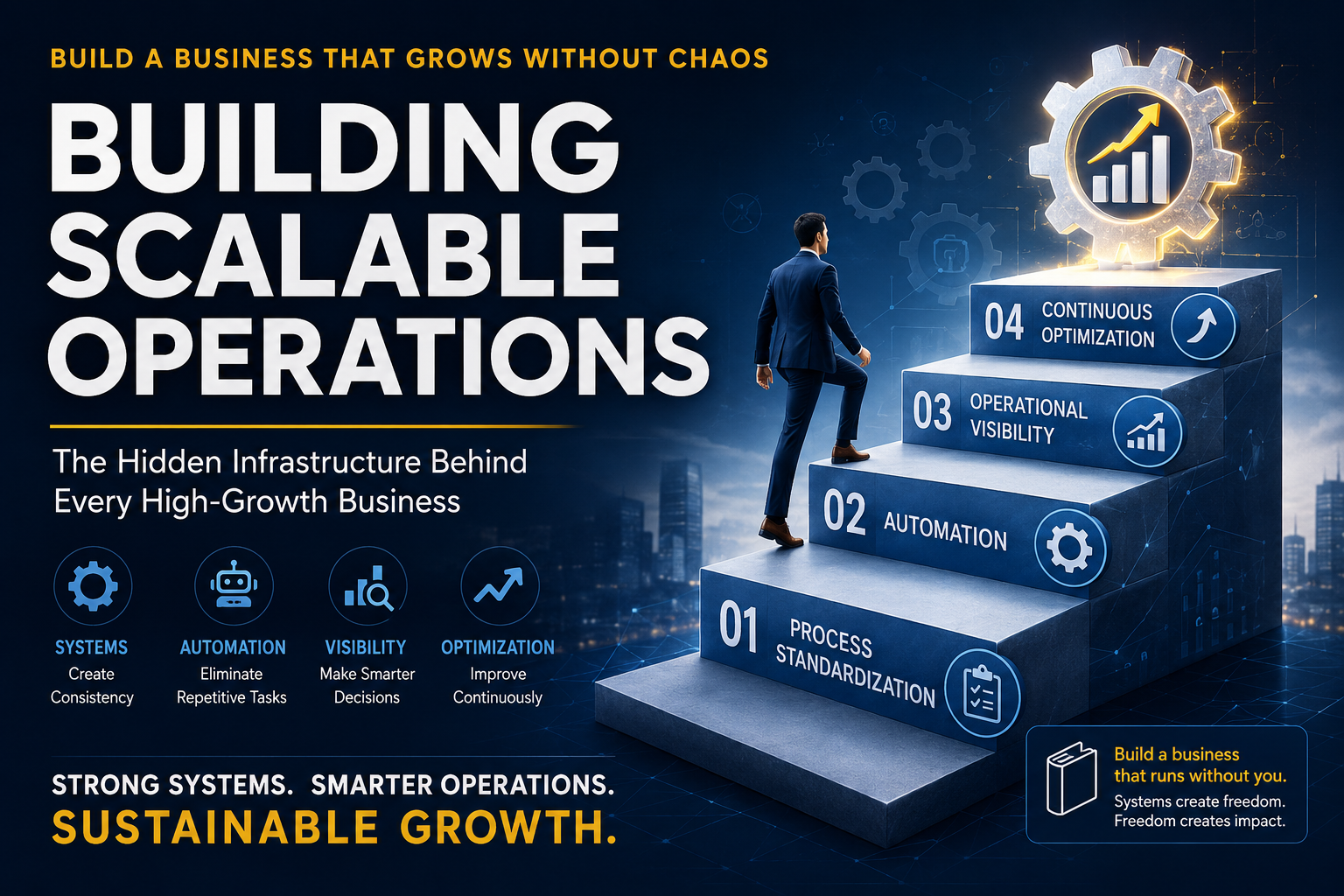
Building Scalable Operations: The Hidden Infrastructure Behind Every High-Growth Business
Introduction
Why do some businesses effortlessly grow from a one-person operation into thriving, multi-million-dollar companies while others remain stuck in a perpetual state of constant chaos, firefighting, and founder burnout? This question has puzzled entrepreneurs for decades. The most common answers you will hear involve talent, funding, market timing, or product quality. While these factors certainly play a role, they are not the primary differentiators between success and stagnation.
The real difference lies in something far less glamorous yet infinitely more powerful: operations.
Behind every successful company—from bootstrapped startups to Fortune 500 giants—is a set of scalable operational systems that allow growth to happen without creating confusion, bottlenecks, or employee burnout. While most entrepreneurs spend their waking hours obsessing over sales funnels, marketing campaigns, and revenue generation, the smartest founders understand a fundamental truth that many learn too late: sustainable growth is impossible without a solid operational foundation.
A business can survive for a while with improvised processes, gut-feeling decisions, and manual workarounds. In the early days, this scrappy approach is often necessary. However, once growth begins, every weakness inside the organization becomes magnified under the microscope of volume. Customer inquiries increase exponentially. Orders multiply beyond manual processing capacity. Financial management becomes a labyrinth of spreadsheets and missing receipts. Team coordination becomes a nightmare of miscommunication and duplicated efforts. Without systems, growth does not create success; it creates disorder, stress, and eventual failure.
This is precisely why scalable operations represent one of the most important competitive advantages in modern business. They are the hidden infrastructure that allows you to grow your top line without destroying your bottom line or your sanity.
In this comprehensive guide, you will discover exactly how scalable operations work, why they matter more than ever in today’s fast-paced economy, and how entrepreneurs can build operational systems that support long-term growth without sacrificing efficiency, profitability, or personal freedom. Whether you are generating $10,000 per month or $1 million per month, the principles outlined here will transform how you think about running your business.
What Are Scalable Operations? A Deep Dive
Before we explore the how, we must first establish a crystal-clear definition of the what. Scalable operations refer to the integrated collection of systems, workflows, documented processes, automation tools, and management structures that allow a business to handle increasing levels of activity—whether that means more customers, more transactions, or more employees—without requiring proportional increases in effort, cost, or organizational complexity.
In the simplest possible terms, scalable operations allow a company to grow while remaining organized, efficient, and profitable. Think of it as the difference between a bicycle and a commercial airliner. A bicycle works perfectly for one person traveling a short distance. But if you need to transport 200 people across an ocean, you do not simply add more bicycles. You need a completely different kind of infrastructure—one designed for scale.
Let us illustrate this with a practical business example. Imagine two different businesses, both generating $10,000 per month in revenue. At this level, both companies appear equally successful. The founder of Company A handles everything personally: answering emails, processing orders, sending invoices, managing customer support, and reconciling bank statements. The founder of Company B has done the same up to this point.
Now, imagine that both companies suddenly double their sales to $20,000 per month. This is good news, right? In theory, yes. But watch what actually happens. Company A has no documented procedures, no automated workflows, no customer management system, and no financial dashboards. They rely entirely on the founder’s memory, manual data entry, endless spreadsheets, and constant firefighting. When sales double, the founder must work twice as hard, make twice as many decisions, and put out twice as many fires. Within weeks, the founder is exhausted, customers are complaining about delays, and errors are multiplying.
Company B, on the other hand, has already invested in documented procedures, automated invoicing, a customer relationship management system, financial dashboards, and clear operational workflows. When sales double, the systems handle the increased volume seamlessly. The founder barely notices the increase in workload because the infrastructure absorbs the growth.
Which business is more likely to survive and thrive? The answer is obvious. Yet most entrepreneurs continue to operate like Company A, wondering why they feel so overwhelmed.
Here is a critical truth that every business owner must internalize: growth does not create operational problems. Growth merely exposes operational problems that already existed. If your systems break when you double your volume, your systems were broken before. You simply did not have enough volume to notice the cracks. This is why successful entrepreneurs invest in operational infrastructure long before they actually need it. They build the highway before the traffic arrives.
Why Most Small Businesses Struggle to Scale: The Founder Bottleneck
Despite the clear logic of building scalable operations, the vast majority of small businesses never achieve true scalability. Why? Because many entrepreneurs mistakenly believe that scaling simply means increasing sales. They pour all their energy into marketing, lead generation, and closing deals, treating revenue as the sole measure of progress.
In reality, sales are only one part of the equation. They are the fuel, but operations are the engine. If your engine cannot handle the fuel you are pouring in, you will not go faster. You will simply blow up. Increased sales without corresponding operational capacity often create bigger problems than the ones you were trying to solve.
Here are the most common symptoms of a business that lacks scalable operations:
- Missed customer requests and forgotten follow-ups that damage trust and reputation
- Delayed deliveries and late project completions that frustrate clients
- Financial confusion where you cannot accurately predict cash flow or profitability
- Employee frustration caused by unclear roles, conflicting instructions, and constant emergencies
- Increased errors in order processing, billing, and customer communication
- Poor internal communication where information gets lost between team members
- Founder burnout characterized by 80-hour work weeks and the feeling that everything depends on you
These issues are not caused by growth itself. They are caused by a lack of scalable systems. When a business operates without documented processes, every situation becomes a unique event requiring a fresh decision. Every customer request becomes a new problem to solve. Every financial transaction requires manual attention.
This creates what many experts call the “founder bottleneck.” In this all-too-common scenario, the founder becomes the system. Nothing happens without the founder’s approval. No decision gets made without the founder’s input. No problem gets solved unless the founder intervenes. The founder is the central processor through which every piece of information must pass.
Here is the harsh reality that keeps entrepreneurs trapped in this cycle: human beings do not scale. You have exactly 24 hours in each day. You have a finite amount of mental energy, focus, and willpower. No matter how talented, disciplined, or hardworking you are, there is a hard limit to what one person can do. Systems, on the other hand, scale infinitely. A well-designed automated workflow can process ten transactions or ten million transactions with the same marginal cost.
The reason many entrepreneurs remain trapped in the founder bottleneck is that they focus on working harder rather than designing better systems. They wear their exhaustion as a badge of honor, believing that hustle is the secret to success. But hustle without infrastructure is just burnout waiting to happen. The most successful founders understand that their primary job is not to work inside the business but to build the business. They are architects, not operators.
For those ready to break free from this cycle, a deeper exploration of this topic is available in The Architect’s Blueprint: Build the System That Pays You — Even When You’re Not Working. This resource explains exactly how entrepreneurs can transition from being the bottleneck to becoming the architect of a self-sustaining business system.
The Four Pillars of Scalable Operations
Every scalable organization, regardless of industry or size, is built upon four foundational operational pillars. These pillars work together to create a cohesive infrastructure that supports growth without chaos. If any one of these pillars is weak, the entire structure becomes unstable.
Pillar 1: Process Standardization
Standardization is the discipline of ensuring that important activities are performed the same way every time, regardless of who is performing them. Without standardization, outcomes depend entirely on individual memory, personal habits, and situational judgment. This might work acceptably in a very small team, but it fails catastrophically as the organization grows.
With standardization, outcomes become predictable, measurable, and improvable. You cannot improve a process that you have not defined. You cannot delegate a task that exists only in your head. You cannot automate a workflow that you have not documented.
Examples of standardization in action include:
- Written sales procedures that outline every step from initial contact to closing
- Standardized customer onboarding checklists that ensure no step is missed
- Documented inventory management protocols that prevent stockouts and overordering
- Consistent financial reporting templates that allow month-over-month comparison
- Scripted client communication templates for common scenarios
The benefits of process standardization extend far beyond efficiency. Documented processes significantly reduce errors because there is no ambiguity about what needs to be done. They improve quality because best practices are codified and repeated. Most importantly, they allow new team members to become productive in days rather than months. Instead of relying on tribal knowledge passed down informally, new hires can simply follow the documented playbook.
Pillar 2: Automation
Automation is arguably the most powerful driver of scalability available to modern businesses. Every repetitive task that requires human attention consumes time, money, and mental bandwidth. When you multiply these small inefficiencies across hundreds or thousands of transactions per month, the costs become staggering. Automation eliminates unnecessary manual work, freeing your team to focus on high-value activities that actually require human judgment and creativity.
The beauty of modern automation is that you no longer need technical expertise or expensive developers to implement it. User-friendly tools have democratized automation, making it accessible to solo entrepreneurs and small teams.
Powerful automation examples include:
- Automated invoicing that generates and sends invoices the moment an order is completed
- Email sequences that nurture leads without any manual intervention
- CRM workflows that automatically assign tasks, update records, and trigger follow-ups
- Lead nurturing campaigns that deliver targeted content based on user behavior
- Payment reminders that reduce late payments without awkward manual collection calls
- Customer support routing that directs inquiries to the right person instantly
Businesses that embrace automation consistently report higher productivity, lower operating costs, fewer errors, and dramatically reduced stress levels. Automation does not replace people; it empowers them to do their best work without being buried in administrative drudgery.
For entrepreneurs seeking a practical, no-coding-required implementation roadmap, AUTOMATE YOUR BUSINESS IN 7 DAYS (NO CODING): Build a System That Runs Without You provides a step-by-step framework. This resource focuses exclusively on practical automation systems that can be implemented quickly, without technical expertise, and with immediate tangible results.
Pillar 3: Operational Visibility
You cannot manage what you cannot measure. You cannot improve what you do not track. Yet a shocking number of businesses operate with almost no visibility into what is actually happening inside their own operations. Founders often make critical decisions based on gut feelings, outdated information, or outright assumptions.
Without operational visibility, founders typically cannot answer basic questions such as:
- Which products or services are actually the most profitable after accounting for all costs?
- Which customers generate the highest lifetime value versus which ones cost more to serve than they pay?
- Where is money leaking out of the business through inefficiencies, errors, or waste?
- Which processes create bottlenecks that slow down everything else?
- How are team members actually spending their time?
Operational visibility requires implementing dashboards, automated reports, and real-time performance metrics that give you an accurate picture of your business at any moment. When entrepreneurs have access to reliable, timely data, they make dramatically better decisions. They can spot problems before they become crises. They can identify opportunities that would otherwise remain hidden. They can allocate resources to the activities that generate the highest returns.
Without visibility, entrepreneurs operate blindly. They might feel busy, but they cannot distinguish between productive activity and mere motion. This issue becomes particularly dangerous when financial blind spots remain hidden for months or even years, silently eroding profitability while the founder remains blissfully unaware.
A comprehensive framework for identifying and eliminating these hidden risks can be found in The 7 Financial Blind Spots That Keep Entrepreneurs Broke — And Why You Must Automate Your Business to Build Real Wealth. Understanding where your blind spots are located is often the critical first step toward building truly scalable operations that generate sustainable wealth rather than just busyness.
Pillar 4: Continuous Optimization
The final pillar is perhaps the most important because it ensures that the other three pillars continue to improve over time. Scalable businesses are never static. They do not build a system, declare it finished, and move on. Instead, they constantly refine, improve, and optimize their operations.
High-performing organizations regularly ask themselves four critical questions:
- What can be simplified? Is there unnecessary complexity that we can remove?
- What can be automated? Are we still doing manually what could be handled by software?
- What can be delegated? Is this task something only I can do, or can someone else handle it?
- What can be measured? Are we tracking the right metrics to drive improvement?
This discipline of continuous improvement creates a culture of operational excellence that compounds over time. Small, incremental optimizations—improving a process by one percent, automating one additional step, eliminating one small bottleneck—might seem insignificant in isolation. But over months and years, these small improvements compound into massive competitive advantages.
Businesses that continuously optimize their systems often outperform larger, better-funded competitors simply because they can move faster, adapt more quickly, and operate more efficiently. They do not need more resources; they need better systems. And they build those systems one small improvement at a time.
Why Financial Systems Are Essential for Scalable Growth
One of the biggest and most dangerous misconceptions in entrepreneurship is the belief that revenue equals success. Walk into any networking event, and you will hear founders proudly announcing their top-line numbers as if revenue were the sole measure of achievement.
Revenue is important. Without it, you have no business. However, revenue without financial visibility and control can be actively dangerous. Many businesses appear wildly successful on the surface while quietly losing money month after month. They generate plenty of sales, but they have no idea where the money goes. They confuse cash flow with profitability. They mistake activity for achievement.
The problem is rarely a lack of sales. The problem is almost always a lack of financial systems. When your financial operations are manual, fragmented, or nonexistent, you are flying blind. You cannot make strategic decisions because you do not have accurate data. You cannot invest confidently because you do not know your true margins. You cannot scale because you do not know which activities are actually profitable.
Entrepreneurs frequently underestimate the impact of several hidden threats:
- Cash flow leaks caused by untracked expenses, subscription bloat, and inefficient processes
- Poor forecasting that leads to cash crunches despite rising sales
- Untracked expenses that slowly erode margins without anyone noticing
- Revenue concentration risks where a single client represents dangerous percentage of income
- Manual financial management that consumes dozens of hours per month and introduces errors
These hidden weaknesses eventually limit growth. You cannot scale a business when your financial foundation is cracked. Each new sale adds complexity. Each new customer adds administrative overhead. Each new month adds more data to track, more invoices to send, and more expenses to categorize.
Scalable operations require scalable financial systems. This means automated invoice generation and delivery, automated payment processing and reconciliation, automated expense tracking and categorization, automated financial reporting and dashboarding, and automated cash flow forecasting. When these systems are in place, financial clarity becomes automatic rather than an exhausting monthly scramble.
Financial clarity enables founders to make informed decisions rather than guessing. It allows you to allocate resources to the products, channels, and customers that generate the highest returns. It helps you identify growth opportunities before your competitors see them. And it protects you from the silent killers of profitability that hide in the gaps of manual systems.
This entire concept is explored extensively in The Automated Wealth System: How to Eliminate Financial Blind Spots, Automate Your Business, and Build Continuous Income — Even If You’re Starting From Scratch. The framework presented in that resource demonstrates exactly how automation and financial visibility work together to create sustainable wealth and long-term business stability, rather than the boom-and-bust cycle that traps so many entrepreneurs.
Practical Steps to Start Building Your Scalable Operations Today
Understanding the principles is essential, but implementation is everything. Here are five practical steps you can take right now to begin building scalable operations in your own business.
First, conduct a process audit. For one full week, document everything you do. Every email you send, every decision you make, every task you complete. At the end of the week, review your list and identify every task that is repetitive, rules-based, or purely administrative. These are your prime candidates for standardization and automation.
Second, create a single source of truth. Stop scattering your information across email, spreadsheets, sticky notes, and your memory. Implement a customer relationship management system, a project management tool, and a financial platform that all integrate with each other. Your entire team should have access to the same real-time information.
Third, document your top ten most frequent processes. Start with the activities you do every single day. Write down the steps in simple, clear language that anyone could follow. Use screenshots, videos, or checklists. The format matters less than the existence of documentation.
Fourth, automate one repetitive task this week. Do not try to automate everything at once. Pick one task that consumes at least one hour of your time each week. Find a tool that can handle it automatically. Set it up. Test it. Move on to the next task next week.
Fifth, create a simple dashboard of your three most important metrics. Revenue is obvious, but what about customer acquisition cost, average transaction value, gross margin, or cash conversion cycle? Pick three metrics that genuinely predict the health of your business and track them religiously.
Conclusion
Scalable operations are not a luxury reserved for large corporations with unlimited budgets. They are a necessity for any entrepreneur who wants to grow beyond their personal capacity without sacrificing their sanity, their profitability, or their freedom. The choice is stark: you can either build systems that work for you, or you will remain the system, working endlessly just to keep the wheels from falling off.
The hidden infrastructure behind every high-growth business is not magic. It is not talent or luck or timing. It is simply the disciplined, intentional construction of systems that allow growth to happen smoothly, efficiently, and profitably. Start building your scalable operations today. Your future self will thank you.
If you are building a business and planning to grow, this article explains why rapid expansion destroys so many companies — and how to build a scalable automated business that lasts.
📖 Read the full article:
For entrepreneurs who want to go deeper into automation, financial systems, and scalable business architecture:
📘 The Automated Wealth System
https://ebooks.invexsales.com/b/the-automated-wealth-system-how-to-eliminate-financial-blind-spots-automate-your-business-and-build-continuous-income-even-if-you-re-starting-from-scratch
📘 AUTOMATE YOUR BUSINESS IN 7 DAYS (NO CODING)
https://ebooks.invexsales.com/b/automate-your-business-in-7-days-no-coding-build-a-system-that-runs-without-you
📘 The 7 Financial Blind Spots That Keep Entrepreneurs Broke
https://ebooks.invexsales.com/b/the-7-financial-blind-spots-that-keep-entrepreneurs-broke-and-why-you-must-automate-your-business-to-build-real-wealth
📘 THE ARCHITECT’S BLUEPRINT
https://ebooks.invexsales.com/b/the-architect-s-blueprint-build-the-system-that-pays-you-even-when-you-re-not-working
The future belongs to businesses built on systems, not stress.
#BusinessSystems #BusinessAutomation #Entrepreneurship #ScalableBusiness #StartupGrowth #BusinessGrowth #Automation #DigitalBusiness #OperationsManagement #InvexSales
Share this content:







Post Comment