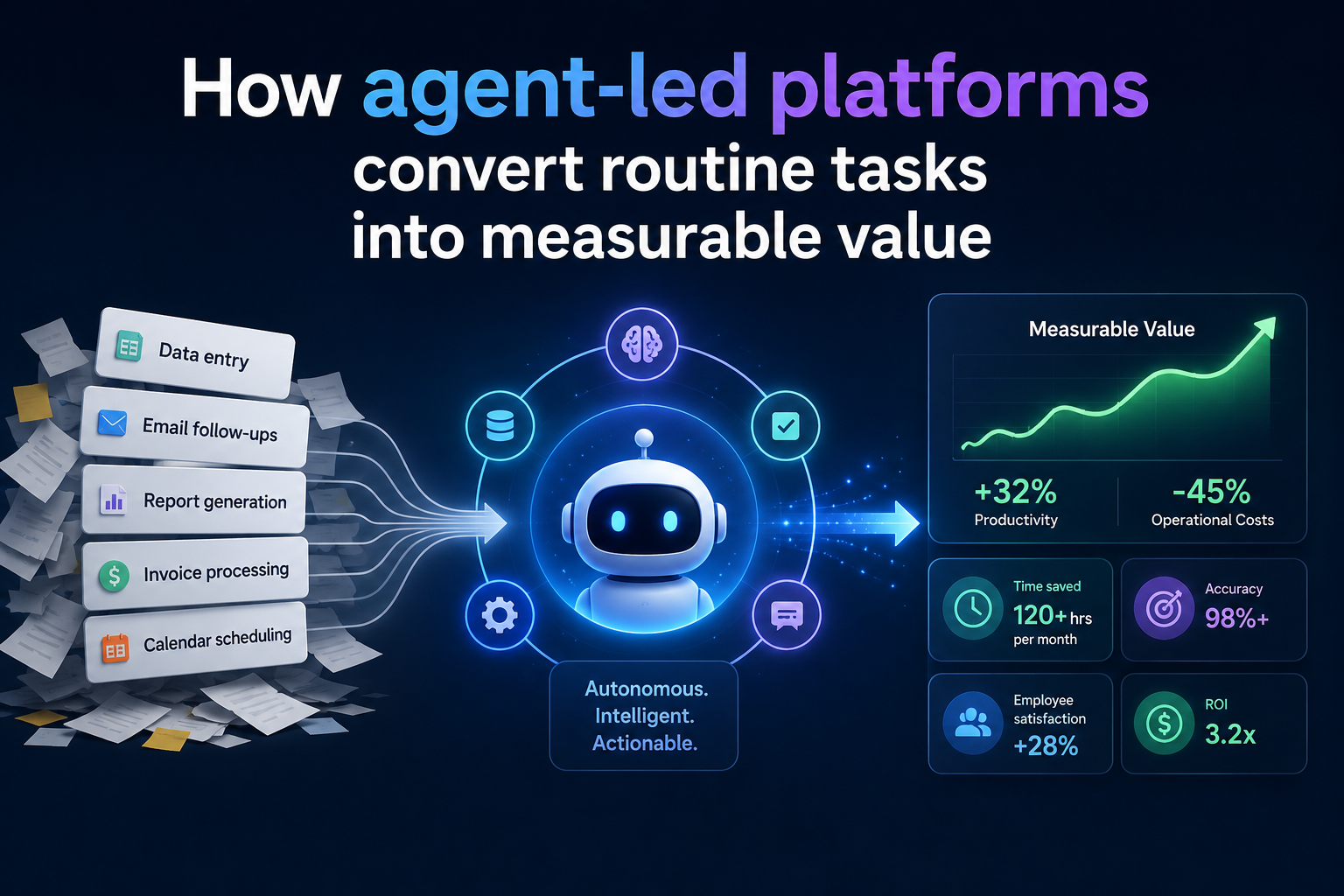
How agent-led platforms convert routine tasks into measurable value
Routine work has always been a hidden tax on growth. Founders and operators feel it in repetitive approvals, manual data entry, status updates, document handling, customer responses, and back-office coordination that consume hours without creating clear strategic advantage. What changes with agent-led platforms is not simply that tasks get automated, but that these activities are connected to measurable business outcomes such as lower labor cost, faster cycle times, fewer errors, and improved service consistency.
That shift matters because businesses no longer evaluate automation by whether a task was completed. They increasingly judge it by whether the system improves unit economics, shortens payback periods, and frees people to focus on higher-value work. Microsoft’s guidance around Copilot Studio frames value realization as delivering measurable, repeatable business value, and that idea captures why agent-led platforms are becoming central to scalable business systems.
From Task Automation to Outcome-Based Value
Traditional automation often focused on isolated task completion. A rule fired, a form moved, or a notification was sent. Agent-led platforms go further by orchestrating multi-step workflows, using tools, APIs, documents, and business logic to complete work in context. The result is that businesses can measure not only activity, but impact.
This outcome-based model is becoming the standard for enterprise AI evaluation. Recent 2026 reporting shows deployed agents are increasingly judged by ROI, first-year savings, and payback period rather than novelty. That is a major strategic shift for business leaders because it reframes AI from an experimentation budget into an operational investment with expected returns.
For entrepreneurs and small business leaders, this means the right question is no longer, “Can this platform automate a task?” The better question is, “Can this platform reduce hours, improve turnaround, lower error rates, or increase throughput in a way we can track monthly?” Measurable value begins when automation is linked to business outcomes that matter to the P&L.
The Four Mechanisms That Turn Routine Work Into Measurable Value
Across recent enterprise reports, agent-led platforms consistently create value through four mechanisms: labor-time reduction, error-rate improvement, faster processing, and better orchestration. These are practical, measurable levers that map directly to operational efficiency and sustainable growth. They also provide a simple framework for evaluating whether an automation initiative deserves further investment.
Labor-time reduction is often the fastest win. When agents handle repetitive inbox triage, data gathering, document generation, or internal coordination, teams reclaim hours that can be redirected into sales, customer relationships, financial analysis, or product improvement. OpenAI’s 2025 enterprise reporting found workers already report measurable value from AI use, with notable time savings in accounting and finance, analytics, communications, and engineering.
Error-rate improvement and processing speed are just as important. Routine workflows often break not because they are complex, but because they are repeated so often that even small inconsistencies become expensive. An agent that validates inputs, follows process rules, and completes the same sequence consistently can reduce rework while also compressing turnaround times. Better orchestration then ties everything together by coordinating systems, tool calls, approvals, and exception handling across the workflow.
Why Bounded, High-Frequency Workflows Produce the Best ROI
Recent industry reporting suggests that agent value is strongest in bounded, high-frequency workflows. In plain terms, the biggest returns often come from processes that happen every day, follow recognizable patterns, and rely on structured or semi-structured information. These workflows are easier to instrument, easier to monitor, and easier to improve once deployed.
This is why top-performing teams often start with narrow use cases such as support ticket routing, invoice processing, lead qualification, onboarding steps, recurring reporting, or order-status communication. These processes may appear operationally minor, but their volume creates significant cumulative cost. Automating them produces measurable gains in hours saved, cycle-time reduction, and service-level performance.
Recent reporting also notes that top-quartile performers achieved payback in under 10 months by targeting high-volume, data-intensive tasks first. For SMBs, the opportunity can be even more compelling. A 2026 enterprise trend piece suggests small businesses are adopting narrow, owner-led workflows where payback can be measured in weeks rather than quarters. That is exactly how scalable business automation should be deployed: start where repetition is high, friction is obvious, and value is easy to quantify.
What the Data Says About Productivity, Savings, and Payback
The latest data points to a market that has moved beyond pilot-stage enthusiasm. DigitalOcean’s 2026 Currents research found that 46% of surveyed organizations are deploying AI agents, while 67% of organizations using agents report productivity gains. VentureBeat’s reporting on the same findings highlights task orchestration and workflow automation as leading use cases, reinforcing that agent-led platforms are now operational tools rather than emerging experiments.
Financial outcomes are becoming clearer as well. KXN Technologies’ 2026 research reports a median first-year net saving of $2.4 million among enterprises seeing measurable ROI, and organizations running three or more concurrent autonomous workflows reported median savings above $4 million. The same report says 62% of respondents achieved full payback within 12 months of production deployment, making payback speed a critical buying and governance metric.
Operational performance data adds another layer of credibility. A 2026 enterprise survey reported 35% to 55% operational efficiency improvements from AI agents, while also noting that multi-agent architectures can unlock automation in knowledge-intensive workflows that were previously infeasible. Taken together, these figures show that measurable value from agent-led platforms is no longer theoretical. It is increasingly visible in productivity gains, process efficiency, and financial returns.
Why Orchestration and Observability Matter More Than Raw Capability
As agent programs mature, the conversation is shifting from model capability to operational control. Recent industry analysis indicates that successful programs are increasingly tied to service levels and unit economics. That means leaders need visibility into how an agent reached a decision, which tools it called, where failures occurred, and when human intervention is required.
This is where orchestration and observability become strategic assets. Orchestration defines how agents move through workflows, trigger systems, request approvals, and hand off edge cases. Observability makes those processes inspectable. Teams can monitor decision paths, tool usage, latency, completion quality, and failure patterns. Without that visibility, an automation system may save time in one area while quietly creating hidden costs elsewhere.
For founders and operators, this is a practical governance issue. If you cannot inspect performance, you cannot defend ROI. If you cannot intervene when quality drops, you cannot scale confidently. Agent-led platforms create measurable value not only by doing work, but by making operational performance visible enough to improve over time.
Internal Productivity vs Customer-Facing Value
Not every workflow produces value in the same way. Microsoft’s 2026 business reporting notes that customer-facing agents often have clearer value tracking than internal productivity agents. That makes sense because customer-facing processes usually connect directly to revenue, conversion, response time, retention, or support cost. Their outcomes are easier to monetize.
Internal routine tasks can still create major value, but the measurement model is often less direct. For example, an agent that drafts internal reports, reconciles records, or updates systems may not generate revenue immediately. However, it can save hours per week, reduce errors, improve compliance, and accelerate internal decision-making. Recent reporting suggests executives estimate saving 4.6 hours per week through AI tools, while end users estimate 3.6 hours. Those time gains can compound quickly across a team.
The practical takeaway is to use different measurement lenses for different workflows. Customer-facing agents can be tied to revenue, service levels, and retention. Internal agents may be better evaluated through hours saved, process throughput, quality improvement, and reduced operating burden. Both matter to a scalable business, but they should not be judged by the exact same yardstick.
How Entrepreneurs Should Evaluate Agent-Led Platforms
For entrepreneurs and small business leaders, the best evaluation process is operational, not abstract. Start by identifying workflows that are repetitive, rules-driven, high-frequency, and painful enough that team members complain about them regularly. Then define the baseline: hours spent, average turnaround time, error rate, labor cost, and impact on customer experience or internal execution.
Next, determine whether the agent-led platform can operate across the systems that actually run the workflow. A modern agent is not just a chatbot. As a 2026 arXiv paper notes, modern agents are built on LLMs with tools that access and modify external environments such as file systems, APIs, and websites. That matters because measurable value depends on the platform’s ability to complete end-to-end work, not just generate text.
Finally, evaluate consequentiality. The same paper used O*NET mapping to classify tool domains and task consequentiality, which is useful for business leaders. Low-stakes chores are good starting points, but the highest measurable value often appears when agents support consequential tasks with strong controls. The key is not to automate recklessly. It is to automate in stages, with clear metrics, human oversight, and escalation paths.
Where the Biggest Strategic Advantage Will Come From
The market is moving quickly from single-task automation to coordinated, multi-agent systems. Druid AI’s 2026 benchmark report, based on 15 months of production data across four industries and hundreds of enterprise customers, found two distinct patterns of value creation. That finding reinforces a broader reality: different businesses create measurable value in different ways depending on workflow mix, customer interaction model, and process maturity.
At the same time, mainstream adoption is accelerating. Gallup’s Q1 2026 survey found that 50% of U.S. employees now use AI at work, with 28% using it daily or weekly and 65% feeling positive about its impact on productivity. Thomson Reuters’ 2026 professional services report explicitly identifies automating routine and low-value tasks as a practical AI use case. The adoption curve is no longer driven by hype alone. It is being sustained by visible business utility.
The strategic advantage will belong to businesses that treat agent-led platforms as part of their operating system. OpenAI describes agentic workflow automation as a core enterprise value lever, and broader research has linked AI leadership to stronger business performance. A cited BCG study found AI leaders achieved 1.7x revenue growth, 3.6x greater total shareholder return, and 1.6x EBIT margin over three years. For growth-focused companies, that suggests the upside is not just efficiency. It is better business architecture.
Agent-led platforms convert routine tasks into measurable value when they are deployed with discipline. The winning pattern is clear: choose bounded workflows, connect agents to real systems, instrument outcomes, and track value through labor savings, speed, accuracy, and orchestration quality. That is how automation becomes a scalable business asset instead of a disconnected tech experiment.
For founders and business leaders, the opportunity is practical and immediate. Start with one repetitive workflow that drains time, define baseline metrics, launch with oversight, and measure payback quickly. In a market where operational efficiency and sustainable growth increasingly depend on systems thinking, agent-led platforms offer a direct path from routine work to measurable value.
*************************************************
📖 Read the full article:
If you’re serious about implementing these principles, you may also find these practical resources useful:
📘 The Automated Wealth System
https://ebooks.invexsales.com/b/the-automated-wealth-system-how-to-eliminate-financial-blind-spots-automate-your-business-and-build-continuous-income-even-if-you-re-starting-from-scratch
📘 Automate Your Business in 7 Days (No Coding)
https://ebooks.invexsales.com/b/automate-your-business-in-7-days-no-coding-build-a-system-that-runs-without-you
📘 The 7 Financial Blind Spots That Keep Entrepreneurs Broke
https://ebooks.invexsales.com/b/the-7-financial-blind-spots-that-keep-entrepreneurs-broke-and-why-you-must-automate-your-business-to-build-real-wealth
📘 The Architect’s Blueprint
https://ebooks.invexsales.com/b/the-architect-s-blueprint-build-the-system-that-pays-you-even-when-you-re-not-working
The entrepreneurs who build systems today are the ones who will own scalable businesses tomorrow.
#BusinessSystems #BusinessAutomation #Entrepreneurship #SmallBusiness #BusinessGrowth #ScalableBusiness #OperationsManagement #StartupGrowth #DigitalBusiness #InvexSales
Share this content:







Post Comment