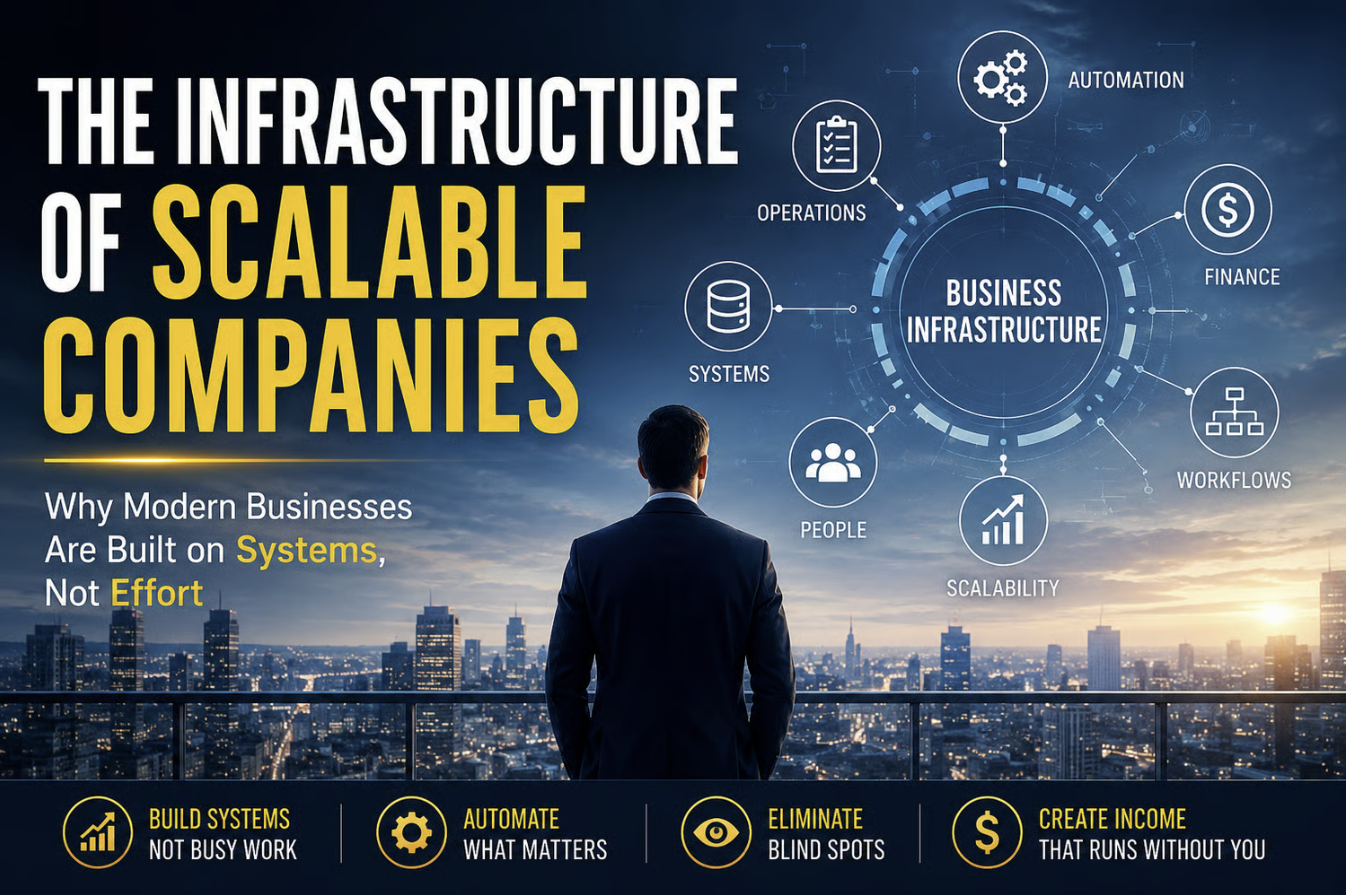
The Infrastructure of Scalable Companies: Why Modern Businesses Are Built on Systems, Not Effort
L. Horizon Walker / The Architect’s Blueprint May 10, 2026
They are built through infrastructure.
The companies that dominate industries are not necessarily the ones with the smartest founders or the biggest teams. They are the ones that build operational systems capable of generating revenue, organizing workflows, automating execution, and scaling without collapsing under complexity.
This is the hidden truth behind modern business growth:
scalable companies are infrastructure companies.
Whether you study technology startups, ecommerce brands, consulting firms, SaaS businesses, or digital creators, the pattern is always the same.
Behind every scalable company lies an invisible operational architecture that powers growth.
And without that infrastructure, growth eventually becomes chaos.
In this guide, you will discover:
- what scalable business infrastructure really means
- why most companies fail during growth
- the systems that power modern scalable businesses
- how automation changes operational economics
- why entrepreneurs must transition from “worker” to “architect”
- how to build a company that generates revenue even when you are not actively working
If you want to build a business that grows sustainably, this article may completely change how you think about entrepreneurship.
What Is the Infrastructure of a Scalable Company?
Most people hear the word “infrastructure” and think about servers, buildings, or software.
But in business, infrastructure is much broader.
Business infrastructure refers to:
- operational systems
- workflows
- automation
- communication systems
- financial tracking systems
- customer management systems
- decision-making structures
- revenue systems
- documentation systems
In simple terms:
infrastructure is the invisible system that allows a business to operate consistently at scale.
A small business can survive without infrastructure.
A scalable company cannot.
This is why many entrepreneurs experience the same painful cycle:
- sales increase
- complexity increases
- operational stress increases
- chaos increases
- performance declines
Growth exposes operational weaknesses.
And without infrastructure, scaling becomes dangerous.
Why Most Businesses Collapse During Growth
One of the biggest myths in entrepreneurship is that growth automatically solves business problems.
In reality:
growth amplifies problems.
If your operations are disorganized at $1,000/month, they will become catastrophic at $100,000/month.
This is because scaling increases:
- customer volume
- communication complexity
- operational dependencies
- decision fatigue
- financial risk
- workflow bottlenecks
Without systems, founders become trapped inside the business.
This is why so many entrepreneurs feel exhausted even after achieving revenue growth.
The business becomes dependent on their constant intervention.
Every task requires their attention.
Every problem reaches their desk.
Every decision depends on them.
Eventually, the founder becomes the bottleneck.
This is precisely why modern scalable companies prioritize systems before expansion.
The Real Difference Between Small Businesses and Scalable Companies
The difference is not motivation.
The difference is not intelligence.
The difference is infrastructure.
Small businesses often rely on:
- manual operations
- founder memory
- reactive decision-making
- inconsistent workflows
- improvised processes
Scalable companies rely on:
- documented systems
- automation
- operational frameworks
- repeatable workflows
- centralized information systems
This distinction changes everything.
A founder operating without systems works harder as the business grows.
A founder operating with systems gains leverage as the business grows.
This is one of the most important principles in modern entrepreneurship:
systems create leverage.
The 7 Core Infrastructure Systems Every Scalable Company Needs
1. Revenue Infrastructure
Revenue infrastructure includes the systems responsible for generating predictable income.
Examples include:
- automated sales funnels
- CRM systems
- lead management systems
- email automation
- customer acquisition workflows
Without revenue infrastructure, businesses depend on unpredictable sales activity.
This is why many entrepreneurs experience unstable income.
The solution is to build systems that continuously attract, nurture, and convert prospects.
A powerful resource for understanding this transformation is:
THE ARCHITECT’S BLUEPRINT: Build the System That Pays You — Even When You’re Not Working
This guide explains how entrepreneurs can design scalable systems that generate continuous revenue instead of depending entirely on manual effort.
2. Financial Infrastructure
Many businesses fail financially not because they lack revenue, but because they lack visibility.
Founders often operate blindly.
They do not fully understand:
- cash flow
- operational costs
- financial leakages
- hidden inefficiencies
- profit structure
These are financial blind spots.
And over time, they silently destroy businesses.
Modern scalable companies build financial infrastructure that provides:
- real-time visibility
- reporting systems
- financial automation
- operational analytics
- forecasting systems
One of the best frameworks for understanding this problem is:
The Automated Wealth System: How to Eliminate Financial Blind Spots, Automate Your Business, and Build Continuous Income — Even If You’re Starting From Scratch
This resource explains how entrepreneurs can eliminate operational blind spots and build automated wealth systems capable of supporting long-term growth.
3. Operational Infrastructure
Operational infrastructure organizes how work gets done inside the company.
This includes:
- task management
- workflow systems
- SOPs
- communication systems
- process documentation
Without operational infrastructure:
- teams become confused
- delays increase
- execution becomes inconsistent
- productivity collapses
Scalable businesses prioritize operational clarity.
They build systems that allow tasks to be executed consistently even as complexity increases.
4. Automation Infrastructure
Automation is one of the defining characteristics of modern scalable companies.
Automation reduces:
- repetitive manual work
- operational dependency
- execution delays
- human error
More importantly:
automation increases leverage.
This is why automation is no longer optional for entrepreneurs who want scalable operations.
A practical framework for implementing automation quickly is:
AUTOMATE YOUR BUSINESS IN 7 DAYS (NO CODING): Build a System That Runs Without You
This guide shows how entrepreneurs can implement operational automation without technical complexity.
5. Decision Infrastructure
As companies grow, decision-making becomes increasingly complex.
Without structure, founders suffer from:
- decision fatigue
- mental overload
- inconsistent priorities
- operational confusion
Scalable companies reduce cognitive overload through systems.
They create:
- dashboards
- KPIs
- reporting systems
- structured review processes
This allows leaders to make faster and better decisions.
6. Customer Infrastructure
Customer experience becomes harder to maintain during growth.
Without systems:
- communication slows
- customer satisfaction declines
- support becomes chaotic
Scalable companies build customer infrastructure through:
- CRM systems
- onboarding systems
- support workflows
- automated follow-ups
This creates consistency across the customer journey.
7. Knowledge Infrastructure
Many businesses operate entirely inside the founder’s head.
This creates enormous risk.
If knowledge is not documented:
- teams become dependent
- onboarding becomes difficult
- execution becomes inconsistent
Scalable companies build centralized knowledge systems.
They document:
- workflows
- processes
- operational guidelines
- strategic frameworks
Knowledge infrastructure allows companies to scale beyond individual memory.
Why Financial Blind Spots Destroy Businesses
One of the most underestimated threats in entrepreneurship is operational blindness.
Many entrepreneurs focus entirely on revenue while ignoring systemic inefficiencies.
This creates hidden problems such as:
- uncontrolled expenses
- cash flow instability
- operational leakages
- low-margin activities
- poor allocation of resources
Over time, these hidden inefficiencies accumulate.
Eventually, the business becomes financially fragile despite generating revenue.
This is why intelligent entrepreneurs prioritize visibility before expansion.
A highly valuable resource on this subject is:
🔥The 7 Financial Blind Spots That Keep Entrepreneurs Broke — And Why You Must Automate Your Business to Build Real Wealth
This guide explores the invisible financial mistakes that quietly limit business growth and explains why automation is essential for long-term wealth creation.
The Hidden Economics of Infrastructure
Most entrepreneurs think infrastructure is expensive.
In reality:
lack of infrastructure is expensive.
Operational chaos creates hidden costs such as:
- wasted time
- duplicated work
- human error
- poor coordination
- burnout
- inconsistent customer experience
These inefficiencies compound over time.
This is why scalable companies invest heavily in systems.
Infrastructure increases operational efficiency.
And operational efficiency increases profitability.
Why Automation Creates Leverage
Leverage is the ability to produce greater results without proportional increases in effort.
Automation is one of the most powerful forms of leverage available to modern entrepreneurs.
Examples include:
- automated lead generation
- automated invoicing
- automated reporting
- automated customer onboarding
- automated email marketing
- automated workflow triggers
Automation transforms businesses from labor-dependent systems into scalable operational machines.
This is one of the defining characteristics of digital businesses.
The internet allows entrepreneurs to build systems capable of operating continuously.
Even while sleeping.
The Founder Transition: From Operator to Architect
One of the hardest transitions in entrepreneurship is psychological.
Founders must stop thinking like workers.
And start thinking like architects.
Operators focus on tasks.
Architects focus on systems.
Operators solve problems manually.
Architects build structures that prevent problems.
Operators trade time for results.
Architects create leverage.
This mindset shift is essential for scalability.
The founders who build scalable companies are rarely the people working the hardest operationally.
They are the people designing the strongest systems.
The Future of Business Belongs to System Builders
Artificial intelligence, automation, and digital infrastructure are changing entrepreneurship permanently.
The businesses that thrive in the future will not necessarily have the biggest teams.
They will have the strongest systems.
This transformation is already visible across industries:
- AI-powered workflows
- automated operations
- digital infrastructure
- intelligent reporting systems
- operational dashboards
- scalable digital ecosystems
Modern entrepreneurship is evolving from manual execution toward intelligent systems design.
This is why system-building is becoming one of the most valuable entrepreneurial skills of the decade.
How Entrepreneurs Can Start Building Infrastructure Today
Many entrepreneurs delay system-building because they believe they are “too small.”
This is a mistake.
Infrastructure should be built early.
The best approach is gradual implementation.
Start with:
Step 1 — Document repetitive tasks
Identify recurring workflows.
Document them clearly.
Step 2 — Centralize information
Create organized systems for:
- operations
- finances
- customers
- reporting
Step 3 — Automate low-value tasks
Focus first on repetitive activities that consume unnecessary time.
Step 4 — Build visibility systems
Track:
- revenue
- expenses
- operational performance
- workflow efficiency
Step 5 — Create scalable workflows
Design operations that can handle increasing volume without collapsing.
The Strategic Advantage of Infrastructure
Infrastructure creates competitive advantage because most businesses avoid building it.
Why?
Because systems require patience.
Operational architecture is invisible.
Many founders prefer visible activities like marketing or branding.
But over time, infrastructure compounds.
And compounding systems become difficult to compete against.
This is why scalable companies often appear unstoppable.
Their growth is supported by invisible operational strength.
Final Thoughts: Businesses Scale Through Systems, Not Effort
The modern economy rewards leverage.
And leverage is built through infrastructure.
The companies that dominate the future will not merely work harder.
They will operate smarter.
They will build:
- automation systems
- financial visibility systems
- scalable workflows
- operational infrastructure
- intelligent business architecture
This is the real foundation of scalable companies.
And entrepreneurs who understand this early gain an enormous strategic advantage.
If you want to go deeper into scalable systems, automation, and business infrastructure, explore these advanced resources:
The Automated Wealth System
How to Eliminate Financial Blind Spots, Automate Your Business, and Build Continuous Income — Even If You’re Starting From Scratch
AUTOMATE YOUR BUSINESS IN 7 DAYS (NO CODING)
Build a System That Runs Without You
🔥The 7 Financial Blind Spots That Keep Entrepreneurs Broke
And Why You Must Automate Your Business to Build Real Wealth
THE ARCHITECT’S BLUEPRINT
Build the System That Pays You — Even When You’re Not Working
The future belongs to entrepreneurs who build systems.
Share this content:




Post Comment