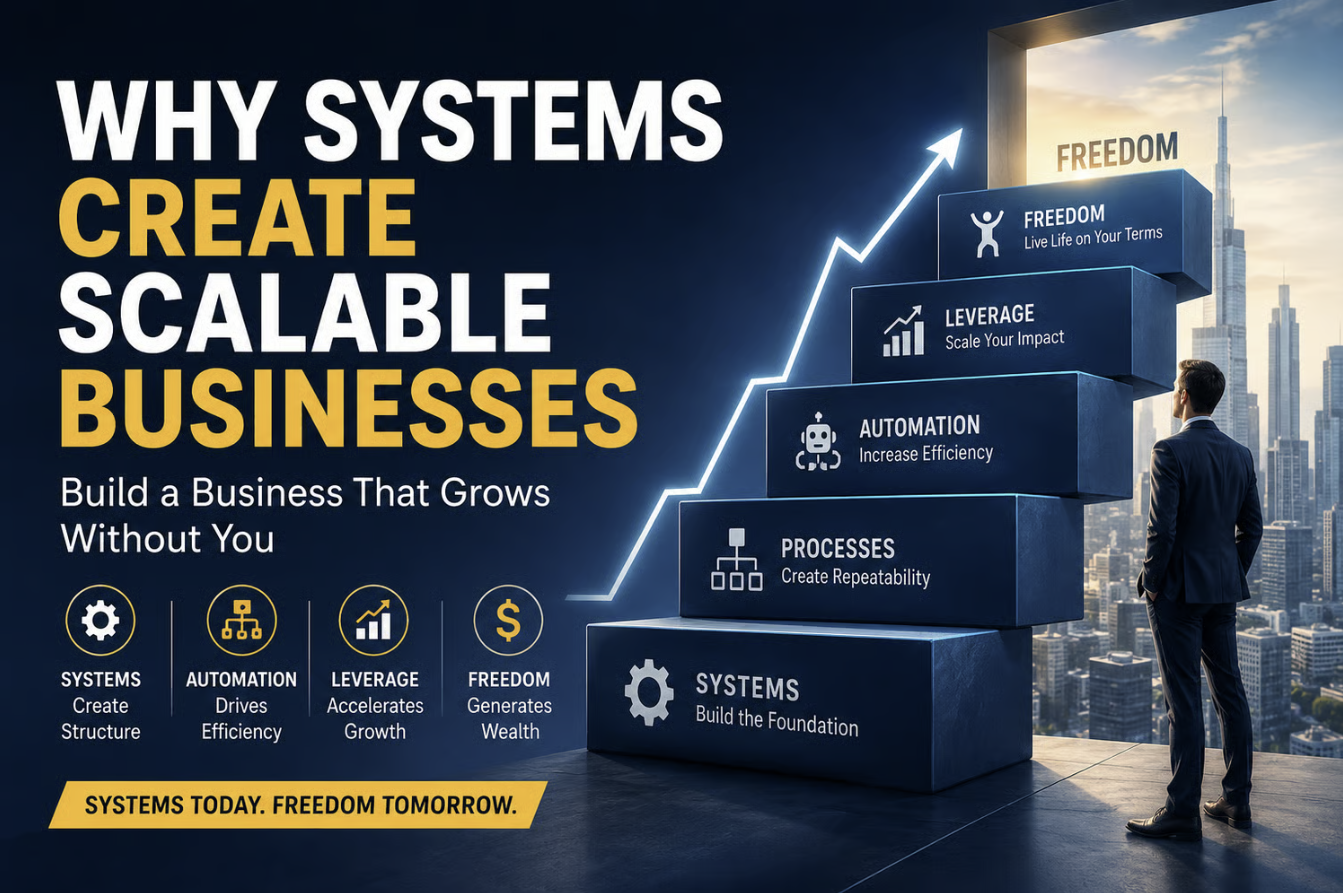
Why Systems Create Scalable Businesses The Hidden Reason Most Businesses Never Scale
L. Horizon Walker / The Architect’s Blueprint May 08, 2026
Introduction
Every year, thousands of entrepreneurs launch businesses with ambition, energy, and vision.
Yet the overwhelming majority never achieve true scalability.
Some remain trapped in survival mode.
Others generate revenue but become operational nightmares.
Many founders eventually discover a painful truth:
Their business cannot grow without their constant presence.
This is the hidden scalability crisis affecting modern entrepreneurship.
The problem is not usually intelligence.
It is not motivation either.
The real issue is the absence of systems.
Scalable businesses are not built on heroic effort.
They are built on operational structures that continue functioning independently of the founder’s daily involvement.
This is why systems create scalable businesses.
And understanding this principle can completely transform the future of your company.
What Is a Scalable Business?
A scalable business is a company capable of increasing revenue without increasing operational complexity at the same rate.
In simple terms:
A scalable business grows faster than its operational burden.
This distinction is critical.
Many businesses generate more sales but simultaneously increase:
- stress
- workload
- operational chaos
- financial confusion
- dependency on the founder
That is not scalability.
True scalability means:
- repeatable operations
- predictable outcomes
- structured workflows
- operational leverage
- automation
- reduced dependency on manual effort
This is why scalable businesses rely heavily on systems.
The Dangerous Myth of Hard Work
Many entrepreneurs still believe scaling comes from:
- working harder
- hiring more people
- grinding longer hours
- multitasking endlessly
But this mindset creates fragile businesses.
A founder-centered company eventually reaches operational saturation.
At some point:
- communication breaks
- financial visibility disappears
- operations become chaotic
- customers experience inconsistency
- growth slows down
The founder becomes the bottleneck.
This is one of the biggest reasons businesses fail to scale.
If you want to understand how entrepreneurs unknowingly sabotage scalability through operational blindness and poor financial structures, this guide provides a deeper framework:
👉 The Automated Wealth System: How to Eliminate Financial Blind Spots, Automate Your Business, and Build Continuous Income — Even If You’re Starting From Scratch
Systems Are the Real Engine of Business Growth
Behind every scalable company lies an invisible infrastructure of systems.
These systems organize:
- operations
- communication
- customer management
- financial tracking
- sales processes
- marketing execution
- workflow automation
- decision-making
Without systems, growth creates chaos.
With systems, growth becomes manageable.
This is the major difference between businesses that collapse under expansion and businesses that scale efficiently.
Why Systems Increase Business Scalability
1. Systems Create Repeatability
A scalable business must produce consistent results repeatedly.
Without systems:
- every task is reinvented
- employees operate differently
- quality fluctuates
- operational errors multiply
Systems create standardized execution.
This standardization allows businesses to grow without losing consistency.
Examples include:
- onboarding systems
- sales workflows
- customer support processes
- operational checklists
- reporting structures
Repeatability creates predictability.
Predictability creates scalability.
2. Systems Reduce Founder Dependency
One of the clearest signs of a non-scalable business is this:
The business stops functioning efficiently when the founder disappears.
This creates enormous operational risk.
Systems reduce dependency on individuals.
When processes are documented and automated:
- teams become autonomous
- operations continue smoothly
- scaling becomes sustainable
This transition from founder dependency to operational independence is one of the most important stages in business evolution.
If you want a practical roadmap for building automated systems without technical complexity, this resource is extremely valuable:
👉 AUTOMATE YOUR BUSINESS IN 7 DAYS (NO CODING): Build a System That Runs Without You
AUTOMATE YOUR BUSINESS IN 7 DAYS (NO CODING)
3. Systems Reduce Operational Chaos
Chaos is one of the biggest enemies of scalability.
As businesses grow, complexity increases naturally:
- more clients
- more transactions
- more communication
- more operational layers
Without systems, complexity becomes overwhelming.
Entrepreneurs start experiencing:
- missed deadlines
- financial confusion
- customer dissatisfaction
- internal inefficiencies
- burnout
Systems absorb complexity.
They organize operational flow into manageable structures.
This is why highly scalable businesses appear “calm” even while handling enormous operational volumes.
4. Systems Improve Decision-Making
Scalable businesses require intelligent decision-making.
But poor operational visibility destroys strategic clarity.
Without systems, founders often operate emotionally instead of analytically.
This leads to:
- poor investments
- cash flow problems
- reactive management
- inconsistent growth
Systems generate operational visibility.
Dashboards, reports, financial tracking, and workflow monitoring allow founders to make informed decisions.
Businesses scale faster when decisions are based on structured data instead of intuition alone.
The Relationship Between Automation and Scalability
Automation is the multiplier effect of systems.
Systems define the structure.
Automation accelerates the execution.
This distinction matters.
A chaotic process automated remains chaotic.
But a structured process automated becomes scalable.
Automation allows businesses to:
- reduce repetitive tasks
- increase operational speed
- lower human error
- improve consistency
- reduce labor dependency
This creates operational leverage.
And leverage is the foundation of scalability.
Why Most Entrepreneurs Resist Systems
Ironically, many entrepreneurs resist systems precisely when they need them most.
Common reasons include:
- “I can do it faster myself.”
- “We’re too small for systems.”
- “We’ll organize later.”
- “Systems slow creativity.”
But avoiding systems creates long-term operational fragility.
Small operational inefficiencies eventually become massive scaling obstacles.
The earlier systems are implemented, the easier growth becomes.
The Scalability Trap Most Businesses Never Escape
Many businesses experience revenue growth without operational maturity.
This creates a dangerous illusion of success.
Revenue increases.
But internally:
- workflows remain disorganized
- reporting stays weak
- finances become unclear
- communication becomes fragmented
Eventually growth exposes structural weaknesses.
This is why many growing businesses suddenly collapse operationally.
Scaling amplifies existing systems.
If the systems are weak, growth magnifies chaos.
If the systems are strong, growth magnifies efficiency.
Financial Systems Are Critical for Scalability
Many entrepreneurs focus heavily on sales while ignoring financial systems.
This creates dangerous blind spots.
A business may generate revenue while simultaneously suffering from:
- cash flow instability
- hidden inefficiencies
- uncontrolled expenses
- poor forecasting
- operational leakage
Scalable businesses require financial visibility.
Financial systems help entrepreneurs:
- track performance
- identify inefficiencies
- monitor cash flow
- optimize profitability
- make intelligent growth decisions
Without financial systems, scaling becomes risky.
If you want to understand the hidden financial mistakes preventing many entrepreneurs from building real wealth, this guide explores the issue deeply:
👉 🔥The 7 Financial Blind Spots That Keep Entrepreneurs Broke — And Why You Must Automate Your Business to Build Real Wealth
The 7 Financial Blind Spots That Keep Entrepreneurs Broke
Systems Create Business Leverage
Scalable businesses rely on leverage.
Leverage means producing larger outcomes without proportional increases in effort.
Systems create leverage by allowing businesses to:
- duplicate processes
- standardize execution
- automate workflows
- optimize operations
- scale teams efficiently
Without systems, growth depends entirely on human effort.
And human effort does not scale infinitely.
The Operational Architecture of Scalable Businesses
Highly scalable companies typically possess structured operational architecture.
This architecture includes:
Sales Systems
Structured lead generation and conversion workflows.
Marketing Systems
Content distribution, automation, and audience nurturing.
Financial Systems
Cash flow tracking, forecasting, and reporting.
Customer Support Systems
Efficient communication and issue resolution.
Operational Systems
Task management, workflows, and process documentation.
Decision Systems
Data-driven reporting and strategic dashboards.
Scalability emerges when these systems operate cohesively.
Why Digital Businesses Scale Faster
Digital businesses often scale faster because they naturally integrate systems and automation.
Examples include:
- online education platforms
- SaaS businesses
- digital product companies
- automated ecommerce businesses
Digital infrastructure allows rapid operational leverage.
This is why modern entrepreneurs increasingly focus on system-driven business models.
The Founder Transformation Required for Scalability
Scaling requires psychological transformation.
Founders must evolve from:
operator → architect
Operators execute tasks.
Architects design systems.
This shift is one of the most difficult transitions in entrepreneurship.
Many founders remain trapped in operational execution because they never develop system thinking.
But scalable businesses require architectural thinking.
This principle is explored extensively in:
👉 THE ARCHITECT’S BLUEPRINT: Build the System That Pays You — Even When You’re Not Working
This framework helps entrepreneurs understand how scalable systems generate operational independence and continuous revenue.
Systems Create Predictable Revenue
One of the greatest benefits of systems is revenue predictability.
Without systems:
- revenue fluctuates heavily
- sales become inconsistent
- operational stress increases
Systems stabilize business performance.
Examples include:
- automated lead generation
- structured customer journeys
- recurring sales processes
- email automation
- retention workflows
Predictability improves strategic planning.
And predictable businesses scale faster.
Why Scalable Businesses Think Long-Term
Businesses without systems often focus only on short-term survival.
But scalable companies design infrastructure for long-term expansion.
This includes:
- process documentation
- automation
- operational frameworks
- data visibility
- scalable technology
Systems transform businesses from reactive operations into structured growth engines.
The Relationship Between Systems and Wealth Creation
Many entrepreneurs chase income.
But scalable businesses generate wealth differently.
They create systems capable of producing continuous value over time.
This distinction matters enormously.
Income depends on effort.
Wealth depends on systems.
This is why system-based entrepreneurship creates greater long-term financial leverage.
Common Signs Your Business Lacks Scalability
Here are major warning signs:
- the founder handles everything
- operations feel chaotic
- tasks are undocumented
- customer experiences vary
- revenue feels unpredictable
- employees require constant supervision
- growth increases stress dramatically
These are not merely operational issues.
They are scalability limitations.
How to Start Building Scalable Systems
Step 1: Identify Repetitive Activities
Look for recurring operational tasks.
Examples:
- customer onboarding
- invoicing
- lead follow-up
- reporting
- scheduling
These activities are ideal candidates for systems and automation.
Step 2: Document Processes
Write down:
- workflows
- procedures
- execution steps
- operational standards
Documentation reduces inconsistency.
Step 3: Simplify Before Automating
Do not automate complexity blindly.
Simplify workflows first.
Then automate.
Step 4: Build Operational Visibility
Use dashboards and reporting systems.
Visibility improves strategic control.
Step 5: Optimize Continuously
Scalable businesses continuously improve systems.
Optimization is an ongoing process.
The Future Belongs to System-Driven Businesses
The business landscape is evolving rapidly.
Modern companies increasingly rely on:
- AI
- automation
- digital workflows
- operational intelligence
- scalable systems
Entrepreneurs who ignore systems risk becoming operationally obsolete.
The future favors structured businesses capable of scaling efficiently.
Final Thoughts
The difference between fragile businesses and scalable businesses is rarely talent alone.
It is systems.
Systems transform effort into leverage.
They reduce chaos.
They improve visibility.
They automate execution.
They create operational independence.
And ultimately, they allow businesses to scale sustainably.
Entrepreneurs who understand this principle early gain enormous strategic advantage.
Because scalable businesses are not built accidentally.
They are architected intentionally through systems.
Recommended Resources for Entrepreneurs Building Scalable Systems
1. The Automated Wealth System
Learn how to eliminate financial blind spots and create automated business structures.
2. AUTOMATE YOUR BUSINESS IN 7 DAYS (NO CODING)
Build operational systems without technical complexity.
AUTOMATE YOUR BUSINESS IN 7 DAYS (NO CODING)
3. The 7 Financial Blind Spots That Keep Entrepreneurs Broke
Understand the hidden financial weaknesses limiting business growth.
The 7 Financial Blind Spots That Keep Entrepreneurs Broke
4. THE ARCHITECT’S BLUEPRINT
Discover how to build systems that generate revenue continuously.
Share this content:




Post Comment