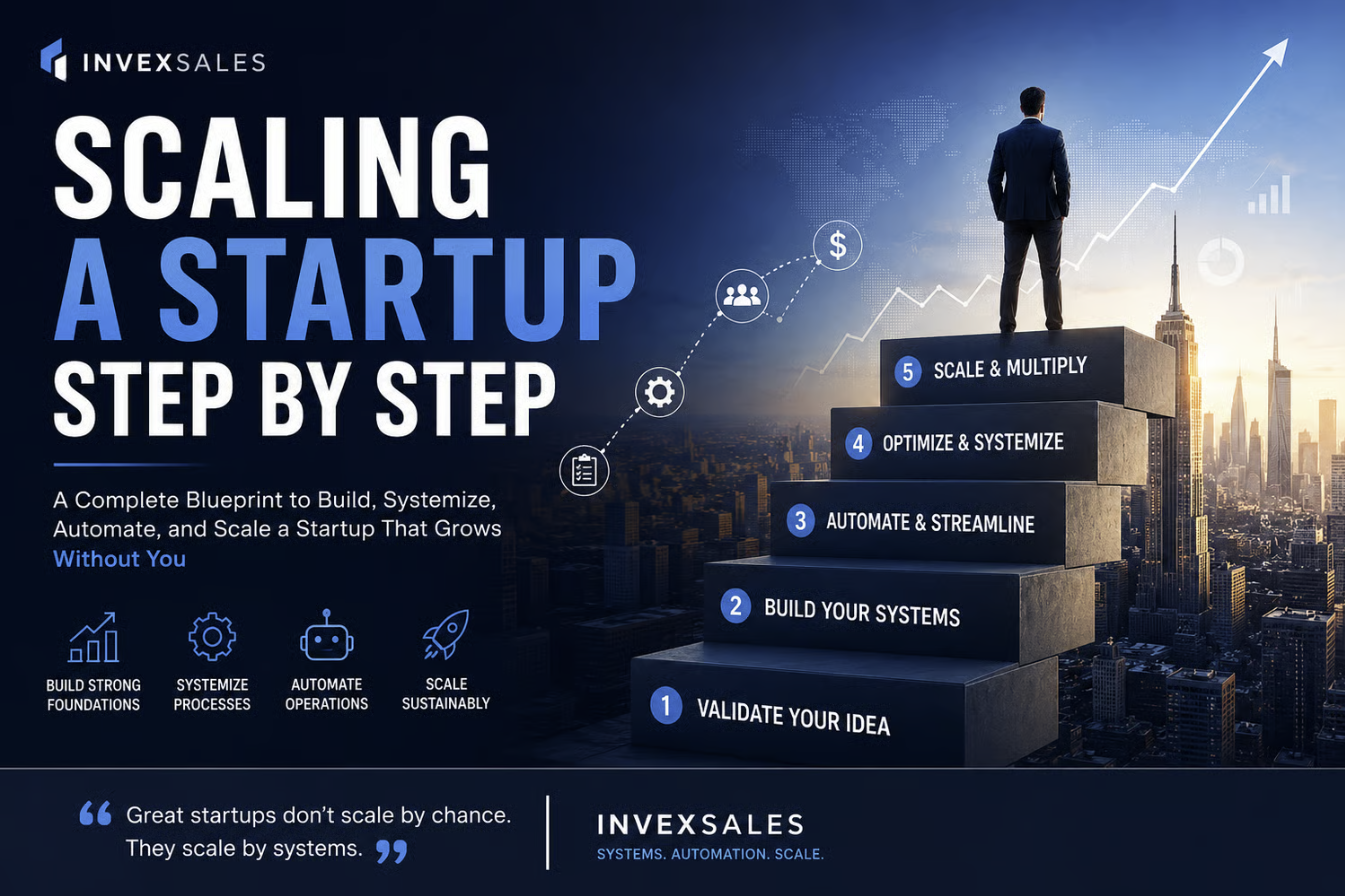
Scaling a Startup Step by Step: The Complete Blueprint for Building a Scalable Business in the United States
L. Horizon Walker / The Architect’s Blueprint May 08, 2026
Introduction: Why Most Startups Never Truly Scale
Every year, thousands of startups launch across the United States with ambitious visions, innovative products, and founders determined to build the next major company.
Yet the brutal reality is this:
Most startups never scale.
Some generate early traction but collapse under operational chaos. Some founders become trapped in endless manual work. Some businesses grow revenue temporarily but eventually hit operational ceilings that prevent sustainable expansion.
The problem is rarely the idea itself.
The real problem is that most startups are built around effort instead of systems.
Founders often believe scaling means:
- hiring more employees
- working harder
- increasing marketing spend
- pushing sales aggressively
But scalable companies are not built on hustle alone.
They are built on:
- systems
- automation
- operational structure
- repeatable workflows
- financial visibility
- intelligent business architecture
This is why some startups evolve into multi-million-dollar companies while others remain permanently stuck in survival mode.
Scaling a startup successfully requires building a business that can grow without collapsing under complexity.
And this is exactly where most entrepreneurs fail.
If you are serious about building a scalable business, understanding operational systems is no longer optional.
This guide will walk you step by step through the startup scaling process while showing you how automation, business systems, and financial visibility create long-term growth.
Along the way, you’ll also discover advanced frameworks from the InvexSales digital business library.
Recommended resources:
- THE ARCHITECT’S BLUEPRINT: Build the System That Pays You — Even When You’re Not Working
- https://ebooks.invexsales.com/b/the-architect-s-blueprint-build-the-system-that-pays-you-even-when-you-re-not-working
- AUTOMATE YOUR BUSINESS IN 7 DAYS (NO CODING): Build a System That Runs Without You
- https://ebooks.invexsales.com/b/automate-your-business-in-7-days-no-coding-build-a-system-that-runs-without-you
- The Automated Wealth System: How to Eliminate Financial Blind Spots, Automate Your Business, and Build Continuous Income — Even If You’re Starting From Scratch
- https://ebooks.invexsales.com/b/the-automated-wealth-system-how-to-eliminate-financial-blind-spots-automate-your-business-and-build-continuous-income-even-if-you-re-starting-from-scratch
- 🔥The 7 Financial Blind Spots That Keep Entrepreneurs Broke — And Why You Must Automate Your Business to Build Real Wealth
- https://ebooks.invexsales.com/b/the-7-financial-blind-spots-that-keep-entrepreneurs-broke-and-why-you-must-automate-your-business-to-build-real-wealth
What Does It Really Mean to Scale a Startup?
A scalable startup is a business capable of increasing revenue significantly without increasing operational costs at the same rate.
In simple terms:
A scalable business can grow efficiently.
This is the difference between:
- a founder-dependent business
- and a system-driven company
A founder-dependent startup grows only when the founder works harder.
A scalable startup grows because systems allow operations to expand predictably.
This distinction is critical.
Many entrepreneurs mistakenly believe revenue growth automatically means scalability.
But revenue alone does not indicate operational maturity.
For example:
A startup generating $30,000 per month may still be operationally fragile if:
- customer management is manual
- sales tracking is inconsistent
- operations are undocumented
- finances are disorganized
- marketing workflows depend entirely on the founder
True scalability means the business can continue operating efficiently even as customer volume increases.
This requires systems.
Step 1: Build a Clear Operational Foundation
Before scaling anything, startups must first stabilize operations.
This is where many founders fail.
They attempt aggressive growth while their business infrastructure remains fragile.
Scaling chaos only creates larger chaos.
At this stage, founders should focus on:
- documenting workflows
- clarifying business processes
- identifying operational bottlenecks
- standardizing recurring tasks
- building visibility into finances
The goal is to create repeatability.
If your startup cannot repeat results consistently at a small scale, scaling will amplify inefficiency.
This is why operational systems matter more than motivation.
One of the biggest mistakes entrepreneurs make is believing discipline alone can replace structure.
But successful companies are built on systems that reduce dependence on memory, improvisation, and constant decision-making.
This principle is explored deeply in:
THE ARCHITECT’S BLUEPRINT: Build the System That Pays You — Even When You’re Not Working
The book explains how scalable businesses are designed using operational architecture rather than founder exhaustion.
Step 2: Create Systems Before You Need Them
One of the defining characteristics of scalable startups is proactive system creation.
Most struggling entrepreneurs wait until operations become chaotic before attempting organization.
Successful founders do the opposite.
They create systems early.
Key systems every startup should develop include:
Sales Systems
Your sales process should follow a structured workflow.
This includes:
- lead capture
- lead qualification
- follow-up automation
- conversion tracking
- customer onboarding
Without a sales system, growth becomes unpredictable.
Marketing Systems
Marketing should operate consistently.
This means:
- content scheduling
- automated email sequences
- campaign tracking
- SEO systems
- audience segmentation
Financial Systems
Financial visibility is one of the most overlooked areas in startups.
Many founders operate blindly.
They know revenue numbers but lack clarity regarding:
- cash flow
- operational costs
- profit margins
- customer acquisition costs
- financial leakages
This creates dangerous blind spots.
A startup can appear successful while silently bleeding financially.
This issue is explored extensively in:
🔥The 7 Financial Blind Spots That Keep Entrepreneurs Broke — And Why You Must Automate Your Business to Build Real Wealth
The guide explains how operational inefficiencies quietly destroy business growth.
Step 3: Automate Repetitive Operations
Automation is one of the most powerful scaling levers available to startups.
Yet many entrepreneurs delay automation because they assume it requires advanced technical skills.
This is no longer true.
Modern no-code tools allow founders to automate large portions of their operations without writing software.
Automation can eliminate:
- repetitive administrative tasks
- manual customer communication
- inconsistent reporting
- duplicated work
- operational delays
More importantly, automation creates consistency.
And consistency is essential for scalability.
Examples of startup automations include:
- automatic email onboarding
- invoice generation
- CRM updates
- task notifications
- customer support workflows
- sales reporting
- lead management
Every manual task creates operational friction.
As customer volume increases, friction compounds.
This is why startups that fail to automate eventually become operationally overwhelmed.
A detailed practical framework for implementing startup automation can be found in:
AUTOMATE YOUR BUSINESS IN 7 DAYS (NO CODING): Build a System That Runs Without You
This resource is particularly valuable for founders seeking fast implementation strategies.
Step 4: Develop Financial Intelligence
One of the biggest differences between scalable startups and struggling businesses is financial visibility.
Many founders focus heavily on revenue while ignoring operational efficiency.
But sustainable scaling depends on understanding:
- cash flow
- profitability
- operational costs
- growth efficiency
- financial sustainability
Without financial intelligence, startups often grow into instability.
This phenomenon is surprisingly common.
A company may increase revenue rapidly while simultaneously increasing inefficiency.
This creates hidden operational debt.
Financial blind spots can include:
- underpricing services
- excessive operational spending
- customer acquisition inefficiencies
- weak profit margins
- poor forecasting
- unmanaged subscriptions
- cash flow instability
Scalable startups build systems that provide constant financial visibility.
This is one of the core ideas behind:
The Automated Wealth System: How to Eliminate Financial Blind Spots, Automate Your Business, and Build Continuous Income — Even If You’re Starting From Scratch
The book explores how automation and financial structure create long-term wealth rather than temporary revenue spikes.
Step 5: Build Repeatable Customer Acquisition Systems
Many startups experience temporary growth through random marketing success.
But scalable businesses rely on predictable customer acquisition systems.
This means building repeatable processes for:
- traffic generation
- lead conversion
- customer retention
- audience nurturing
Scalable customer acquisition usually includes:
SEO Systems
Search engine optimization remains one of the most powerful long-term traffic systems.
Unlike paid advertising, SEO compounds over time.
High-quality content can generate traffic for years.
This is why many modern startups invest heavily in:
- educational content
- authority building
- keyword targeting
- content clusters
- topical authority
Email Systems
Email marketing allows startups to build owned audiences.
Unlike social media platforms, email lists remain under direct business control.
Automated email systems help:
- nurture leads
- educate customers
- increase conversions
- improve retention
Content Systems
Content marketing is not simply about publishing random articles.
Scalable startups use structured content systems designed around:
- audience intent
- SEO keywords
- educational positioning
- authority building
This creates compounding growth.
Step 6: Build a Business That Can Operate Without Constant Founder Presence
One of the clearest signs of a non-scalable startup is founder dependency.
If every decision, operation, or workflow requires direct founder involvement, growth becomes limited.
At some point, the founder becomes the bottleneck.
This is one of the most dangerous operational realities in entrepreneurship.
Many startups do not fail because demand disappears.
They fail because operations cannot scale beyond the founder’s personal capacity.
This is why systems must eventually replace constant supervision.
A scalable startup should gradually transition toward:
- documented operations
- delegated workflows
- automated communication
- centralized information
- standardized processes
The goal is not to remove leadership.
The goal is to remove operational fragility.
This concept is central to:
THE ARCHITECT’S BLUEPRINT: Build the System That Pays You — Even When You’re Not Working
The book explores how entrepreneurs design businesses capable of generating value independently from constant founder effort.
Step 7: Build Operational Infrastructure for Growth
As startups grow, operational complexity increases.
Without infrastructure, growth creates chaos.
This is why scalable businesses invest heavily in operational systems.
Operational infrastructure may include:
- CRM systems
- project management systems
- financial dashboards
- customer support systems
- internal documentation
- workflow automation
Infrastructure creates organizational clarity.
It allows startups to handle increasing volume efficiently.
One of the biggest scaling mistakes founders make is delaying infrastructure investments.
But operational maturity is not optional for scaling.
It is required.
Step 8: Create a Scalable Company Culture
Culture becomes increasingly important during scaling.
As teams grow, operational alignment becomes more difficult.
Scalable startups build cultures centered around:
- clarity
- accountability
- systems thinking
- operational discipline
- continuous improvement
A startup without operational culture eventually develops inconsistency.
This inconsistency reduces scalability.
Strong culture reduces operational friction.
It helps teams execute efficiently without constant supervision.
Step 9: Use Data to Improve Operations
Scalable companies make decisions based on visibility rather than assumptions.
This requires operational data.
Key startup metrics may include:
- customer acquisition cost
- lifetime customer value
- churn rate
- conversion rates
- operational efficiency
- cash flow trends
- marketing performance
Without data visibility, startups operate blindly.
This creates unnecessary risk.
Modern businesses increasingly rely on dashboards, reporting systems, and automation tools to improve operational intelligence.
Step 10: Build Long-Term Scalability Instead of Short-Term Growth
One of the most dangerous startup mistakes is prioritizing rapid growth without operational sustainability.
Scaling should not destroy the business.
True scalability means:
- sustainable growth
- operational efficiency
- financial visibility
- repeatable systems
- reduced dependency on chaos
This requires patience.
Many founders focus on aggressive expansion while neglecting infrastructure.
But scalable businesses are built strategically.
They are engineered.
This engineering mindset is what separates temporary businesses from long-term companies.
Why Automation Is Becoming Essential for Modern Startups
The startup landscape in the United States is becoming increasingly competitive.
Operational efficiency now matters more than ever.
Companies that fail to automate often experience:
- slower execution
- operational burnout
- poor scalability
- inconsistent customer experience
- rising costs
Automation creates leverage.
Leverage allows startups to produce more results with fewer resources.
This is one of the core foundations of scalable entrepreneurship.
Modern founders increasingly use automation for:
- marketing
- operations
- finance
- customer service
- reporting
- communication
- onboarding
Automation is no longer optional.
It is becoming the operational backbone of modern business.
Common Startup Scaling Mistakes
Scaling Without Systems
Growth amplifies operational weaknesses.
Without systems, scaling becomes dangerous.
Ignoring Financial Blind Spots
Revenue alone does not guarantee stability.
Founders must understand operational efficiency.
Delaying Automation
Manual operations eventually become bottlenecks.
Founder Dependency
Businesses dependent entirely on founders cannot scale efficiently.
Lack of Documentation
Undocumented processes create inconsistency.
Operational Chaos
Poor organization destroys scalability.
The New Era of Entrepreneurship: System-Driven Businesses
The future of entrepreneurship belongs increasingly to system-driven companies.
Modern businesses are evolving toward:
- intelligent workflows
- automated systems
- operational visibility
- scalable digital infrastructure
Founders who understand systems gain significant competitive advantages.
This is why operational architecture is becoming one of the most important skills in modern entrepreneurship.
The businesses that dominate the future will not simply work harder.
They will operate smarter.
Final Thoughts: Scaling a Startup Is About Building Systems, Not Just Growth
Scaling a startup successfully requires far more than ambition.
It requires:
- operational structure
- automation
- financial intelligence
- scalable systems
- repeatable workflows
- strategic infrastructure
The startups that survive long term are not necessarily the most creative.
They are often the most operationally organized.
This is why founders must stop thinking only about revenue and start thinking about systems.
Systems create:
- leverage
- efficiency
- predictability
- scalability
- sustainability
If you want to build a startup capable of long-term growth, investing in operational systems is one of the smartest decisions you can make.
Additional recommended resources from InvexSales:
THE ARCHITECT’S BLUEPRINT: Build the System That Pays You — Even When You’re Not Working
AUTOMATE YOUR BUSINESS IN 7 DAYS (NO CODING): Build a System That Runs Without You
The Automated Wealth System: How to Eliminate Financial Blind Spots, Automate Your Business, and Build Continuous Income — Even If You’re Starting From Scratch
🔥The 7 Financial Blind Spots That Keep Entrepreneurs Broke — And Why You Must Automate Your Business to Build Real Wealth
InvexSales continues building educational frameworks designed to help entrepreneurs create scalable, automated, and system-driven businesses for the modern economy.
Share this content:







Post Comment