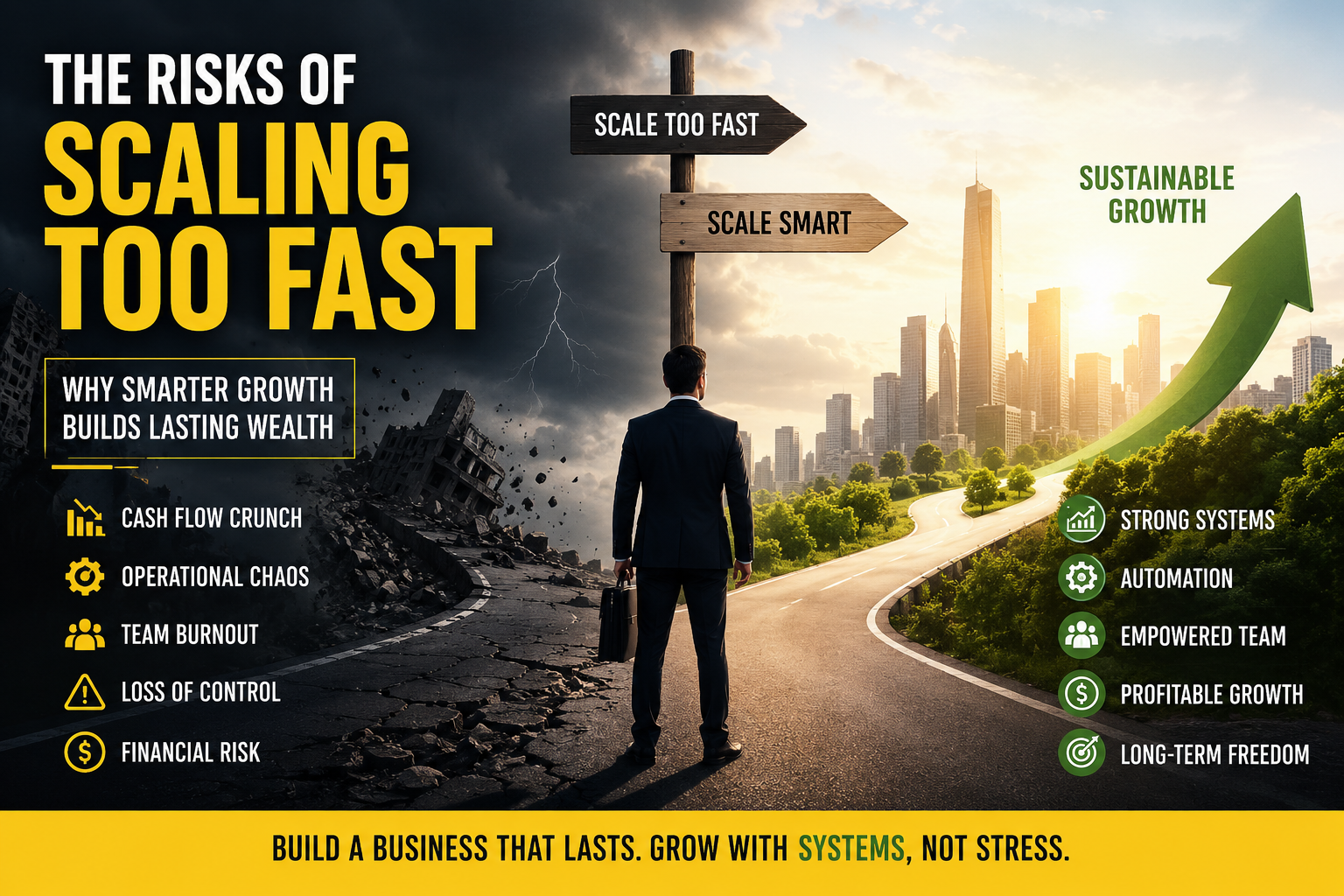
The Risks of Scaling Too Fast: Why 74% of High-Growth Startups Crash (And How to Build a Scalable, Automated Business That Lasts)
You’ve seen the headlines. A SaaS company raises $50 million in Series B funding. A direct-to-consumer brand goes viral on TikTok. A service-based agency lands three enterprise clients in one week.
Within six months, they’re laying off 40% of their staff. Their customer support ticket backlog hits 10,000. The founder is sleeping in the office, drowning in cash flow problems despite “record revenue.”
Welcome to the graveyard of premature scaling.
According to a study by Startup Genome, 74% of high-growth startups fail because they scale too fast. Not because of bad products. Not because of lack of market fit. But because they grew faster than their operational infrastructure could handle.
If you’re an American entrepreneur — whether you’re bootstrapping in a garage in Austin or running a seven-figure e-commerce brand from New York — this article will save you from the most seductive trap in business: the illusion that more revenue fixes everything.
We’ll break down:
- The 7 hidden financial blind spots that emerge during rapid growth
- Why “hiring more people” often makes things worse
- How to build a system that pays you even when you’re not working
- A no-code blueprint to automate your business in 7 days
And along the way, we’ll connect you to proven resources — including four powerful ebooks designed to help you scale intelligently without breaking.
Table of Contents
- The Premature Scaling Epidemic in the US Market
- The 7 Financial Blind Spots That Keep Entrepreneurs Broke
- Why Hiring Your Way Out of Chaos Backfires
- The Architecture of a Scalable Business
- How to Automate Your Business in 7 Days (No Coding Required)
- Case Study: From Burnout to Passive Systems
- Your 90-Day Smart Scaling Roadmap
- Conclusion: Scale Without Sacrifice
1. The Premature Scaling Epidemic in the US Market
Let’s get one thing straight: Scaling is not the same as growing.
- Growing means adding customers, revenue, and headcount in a linear, manageable way.
- Scaling means increasing revenue without a proportional increase in costs, complexity, or your personal workload.
Most founders try to scale before they’ve built the infrastructure to support it. They confuse activity with systems.
The Hard Data
A landmark study of over 3,200 startups by Startup Genome found that premature scaling is the #1 cause of startup death, outpacing product-market fit issues or competition.
In the US alone, the SBA reports that 70% of small businesses fail by year 10, and among those that reach $1M+ in revenue, nearly half collapse within 24 months of a “growth spike.”
Why? Because rapid growth exposes every weakness in your business simultaneously:
- Cash flow becomes unpredictable
- Quality control disintegrates
- Customer support turns into a firefighting operation
- The founder becomes the single point of failure
You start asking yourself: Why am I working 80 hours a week while making more money than ever — yet feeling more stressed than when I started?
The answer is almost always lack of automation and financial blind spots.
2. The 7 Financial Blind Spots That Keep Entrepreneurs Broke
Here’s what most founders don’t realize until it’s too late: You don’t have a revenue problem. You have a leakage problem.
When you scale too fast, money flows in, but it flows out even faster. And because you’re moving at high speed, you don’t see the holes in your financial ship until you’re underwater.
These are the 7 financial blind spots that destroy fast-growing businesses:
Blind Spot #1: Confusing Gross Revenue with Real Profit
You land a 100,000contract.Butafterfulfillmentcosts,softwaresubscriptions,agencyfees,andrefunds,yournetmarginis8100,000contract.Butafterfulfillmentcosts,softwaresubscriptions,agencyfees,andrefunds,yournetmarginis810,000 project at 50% margin.
Blind Spot #2: Invisible Operational Debt
Every manual task you haven’t automated — invoice processing, client onboarding, lead follow-up — becomes exponentially more expensive as volume increases. A task that takes 5 minutes at 10 clients/week takes 500 minutes at 100 clients.
Blind Spot #3: Cash Flow Timing Mismatches
You pay suppliers in 15 days. Your clients pay you in 60 days. During rapid growth, that gap kills more companies than unprofitability.
Blind Spot #4: The Founder Dependency Trap
If only you can close big deals, handle escalations, or approve expenses, you become the bottleneck. Scaling requires a business that runs without you.
Blind Spot #5: Vanity Metrics Addiction
Page views, followers, even revenue spikes — none matter if your customer acquisition cost (CAC) is rising faster than customer lifetime value (LTV).
Blind Spot #6: Absence of Automated Safeguards
No automatic alerts for low cash balance. No recurring billing audits. No profit-first allocations. When you’re scaling manually, mistakes compound daily.
Blind Spot #7: Ignoring Marginal Unit Economics
Your first 100 customers were profitable. Your 101st? Maybe not. As you scale, unit costs change. Most founders discover this after losing $50,000.
Resource Alert: To eliminate these blind spots permanently, get The 7 Financial Blind Spots That Keep Entrepreneurs Broke — And Why You Must Automate Your Business to Build Real Wealth. This ebook walks you through each blind spot with diagnostic tools and specific automation fixes.
3. Why Hiring Your Way Out of Chaos Backfires
When a US startup grows too fast, the founder’s instinct is: “I need more people.”
So you hire three new customer support reps, two project managers, a social media manager, and a “COO” who used to manage a Starbucks.
Suddenly, you have 15 employees. Revenue is up 200%. But profit? Down 30%.
The Hidden Costs of Reactive Hiring
1. Communication Overhead
Fred Brooks’ classic “Mythical Man-Month” law applies here: adding people to a late project makes it later. Every new hire adds coordination complexity. You need meetings, Slack channels, performance reviews, and conflict resolution.
2. Training Debt
Each new employee requires 30–90 days to become productive. During that time, senior people are pulled away from their work to train them. You’re effectively slowing down to speed up.
3. Process Dependency
More humans means more variance. One support agent handles refunds differently than another. One salesperson qualifies leads differently. Without systems, quality degrades as headcount grows.
4. The Founder’s Time Crisis
Instead of working on the business — improving the product or building automations — you’re working in the business, solving interpersonal dramas and approving time-off requests.
The Smarter Path: Systems Before People
The most scalable businesses invert the order:
- Automate every repeatable process first.
- Document what cannot yet be automated.
- Then hire humans to manage exceptions and build relationships.
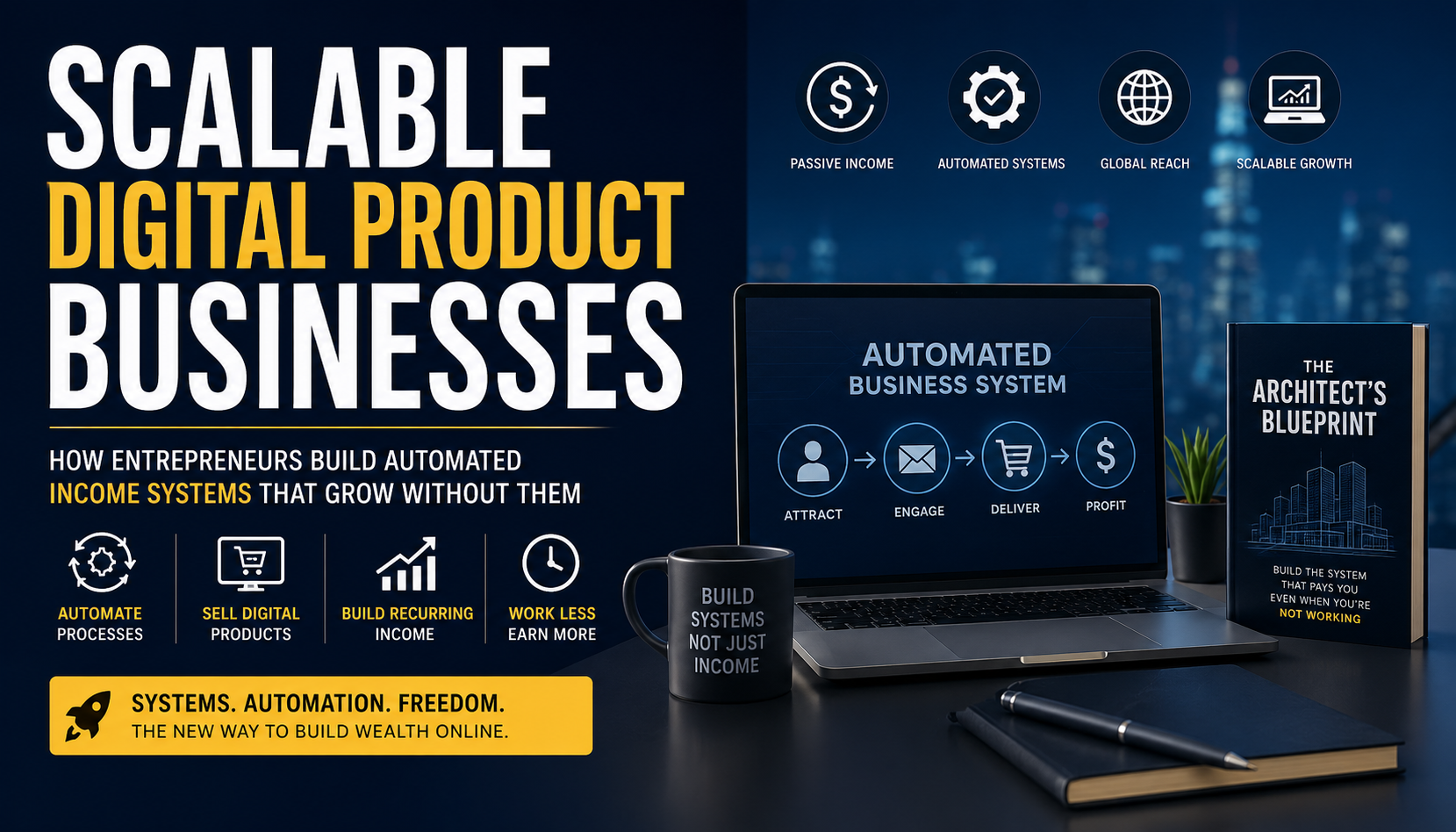
This is exactly what The Architect’s Blueprint: Build the System That Pays You — Even When You’re Not Working teaches. You’ll learn how to design a business architecture where systems do the heavy lifting, and employees enhance — not replace — those systems.
4. The Architecture of a Scalable Business
Think of your business like a skyscraper. If you build the 50th floor before the foundation is cured, the whole structure collapses.
Most founders start adding “floors” (new products, new channels, new hires) without reinforcing the foundation.
The 3 Essential Layers of a Scalable Business
Layer 1: Automated Financial Infrastructure
- Recurring billing that never fails
- Real-time cash flow dashboards
- Profit allocation rules (e.g., 50% operating, 20% owner pay, 15% tax, 15% profit)
- Automated invoice reminders and payment collections
Layer 2: No-Code Operational Systems
You don’t need a technical co-founder or a development team. Modern tools like Zapier, Make, Airtable, and many CRMs allow you to automate:
- Lead capture → qualification → booking
- Client onboarding document collection
- Task assignment and deadline tracking
- Post-project feedback collection
Layer 3: Delegation & Documentation Architecture
- Standard operating procedures (SOPs) for every role
- A training library that any new hire can consume
- Escalation rules (“If X happens, do Y”)
- Quality control checkpoints without your involvement
What Most Founders Miss
The biggest mistake is trying to build all three layers at once. You’ll get overwhelmed and quit.
Instead, start with Layer 1 (financial automation). Then Layer 2 (no-code operations). Then Layer 3 (documentation). This sequence de-risks every step.
For a complete blueprint, The Automated Wealth System: How to Eliminate Financial Blind Spots, Automate Your Business, and Build Continuous Income — Even If You’re Starting From Scratch is your step-by-step manual. It covers exactly how to structure these layers, even if you have zero technical background or a tiny budget.
5. How to Automate Your Business in 7 Days (No Coding Required)
“Automation sounds great, but I don’t have time to learn code. I’m already drowning.”
Good news: You don’t need to write a single line of code. The no-code revolution means that with drag-and-drop tools, you can automate 80% of your manual tasks in one focused week.
Here’s a 7-day plan to go from chaos to cruise control.
Day 1: Audit Your Time
Track every task you do for 24 hours. Categorize as:
- Repeatable (happens more than once per week)
- Rule-based (if A, then B)
- Exception-based (requires judgment)
You’ll discover that 70–80% of your tasks are repeatable and rule-based. Those are automation candidates.
Day 2: Automate Lead Capture & Follow-Up
Connect your CRM to your email marketing tool and calendar. Use a tool like Zapier to:
- When a lead fills out a form → add to CRM → send welcome email → book discovery call.
Manual time saved: 5–10 hours/week.
Day 3: Automate Invoicing & Payment Reminders
Set up recurring invoices in your accounting software (QuickBooks, Xero, Freshbooks). Automate:
- Invoice delivery on the same day each month
- Gentle reminder emails at 7 days, 14 days, and 21 days past due
- Late fee application at 30 days
Day 4: Automate Client Onboarding
Create a standardized onboarding sequence:
- Welcome email with links to a form (use Google Forms or Typeform)
- Automatic creation of project folders (Dropbox/Google Drive)
- Assignment of tasks to team members (Asana/Trello/Monday)
Day 5: Automate Internal Reporting
Set up a dashboard (Airtable + Softr, or Google Looker Studio) that auto-updates:
- Daily revenue
- Support ticket volume
- Task completion rate
- Cash balance
No more “let me pull that report for you.”
Day 6: Document Your Automations
Create simple screen recordings (Loom) explaining each automation. These become your training library. New team members can watch instead of interrupting you.
Day 7: Test & Iterate
Run through your entire customer journey as if you were a new client. Identify broken links, missing triggers, or confusing steps. Fix them.
By Day 8, you should have a business that requires less than 10 hours of your active involvement per week.
If this sounds impossible, it’s not. It’s exactly what Automate Your Business in 7 Days (No Coding): Build a System That Runs Without You delivers — a drill-by-drill, tool-by-tool plan that has worked for thousands of US entrepreneurs.
6. Case Study: From Burnout to Passive Systems <a name=”section6″></a>
The Founder: Sarah K., an Arizona-based digital marketing agency owner.
The Problem: Scaled from 30k/monthto30k/monthto180k/month in 9 months. Hired 12 people. Her personal workload went from 40 hours to 85 hours. Profit margins dropped from 35% to 12%. She was missing her kids’ soccer games and had chest pains from stress.
The Turning Point: She realized her business had zero automations. She manually sent every invoice, onboarded every client, and handled every escalation. “I built a job, not a business,” she said.
The Solution (in her own words):
- Week 1: Read The 7 Financial Blind Spots and discovered she was leaking $12k/month in unbilled hours and forgotten subscription cancellations.
- Week 2: Used Automate Your Business in 7 Days to set up client onboarding automation and recurring billing.
- Month 2: Applied The Architect’s Blueprint to redesign her fulfillment process. Removed herself from daily delivery.
- Month 3: Fully implemented The Automated Wealth System across all three business layers.
The Results (12 months later):
- Revenue: $220k/month (+22%)
- Profit margin: 41% (+29 points)
- Founder hours: 12 hours/week (-86%)
- Customer satisfaction: 94% (higher than before)
- Took a 6-week paid sabbatical for the first time in 8 years
Sarah now runs her business from her phone while traveling with her family. She’s not special — she just followed a system.
7. Your 90-Day Smart Scaling Roadmap
You now know the risks of scaling too fast, the financial blind spots that destroy growth, and the exact automation steps to protect your business.
But knowledge without a timeline is just entertainment.
Here’s your 90-day roadmap to scale safely:
Days 1–30: Diagnose & Automate Finance
- Identify your 7 financial blind spots using the ebook.
- Set up recurring billing and automated payment reminders.
- Create a real-time cash flow dashboard.
- Implement profit-first allocations.
Recommended resource: The 7 Financial Blind Spots + The Automated Wealth System
Days 31–60: Automate Operations
- Complete the 7-day no-code automation challenge.
- Build your client onboarding and lead follow-up automations.
- Document every automation as a training asset.
Recommended resource: Automate Your Business in 7 Days
Days 61–90: Architect for Passive Income
- Remove yourself from every recurring operational role.
- Build escalation rules and quality checkpoints.
- Create the “blueprint” that allows you to step away for 30+ days.
Recommended resource: The Architect’s Blueprint
By Day 90, you should be able to:
- Leave your business for two weeks without emergencies.
- Know your real-time profit margin without manual calculations.
- Onboard new clients without touching your keyboard.
- Scale to 2x your current revenue without doubling your stress.
8. Conclusion: Scale Without Sacrifice
American entrepreneurs are told that growth at any cost is the goal. That hustle culture is the price of success. That burnout is a badge of honor.
That’s a lie.
The real goal is not to grow fast. It’s to grow smart. To build a business that generates continuous income, eliminates financial blind spots, and runs on autopilot — whether you’re starting from scratch or already doing seven figures.
Premature scaling destroys dreams. But strategic automation builds wealth, freedom, and legacy.
You have two choices today:
Option A: Keep scaling manually. Keep reacting to problems. Keep being the bottleneck. Keep wondering why more revenue brings more headaches.
Option B: Spend the next 90 days implementing the systems in these four ebooks. Eliminate your blind spots. Automate your operations. Build an architecture that pays you even when you’re not working.
The choice is yours. But know this: every day you delay automation, you’re adding risk to your business.
Your Next Step
Don’t try to figure this out alone. Thousands of US entrepreneurs have already used these resources to scale safely:
- The Automated Wealth System – For eliminating financial blind spots and building continuous income.
- Automate Your Business in 7 Days – For no-code automation, even if you’re not technical.
- The 7 Financial Blind Spots – For diagnosing why you’re working harder but not getting richer.
- The Architect’s Blueprint – For building the ultimate passive-income machine.
Pick one. Start today. And join the minority of business owners who scale without sacrifice.
Share this content:





Post Comment