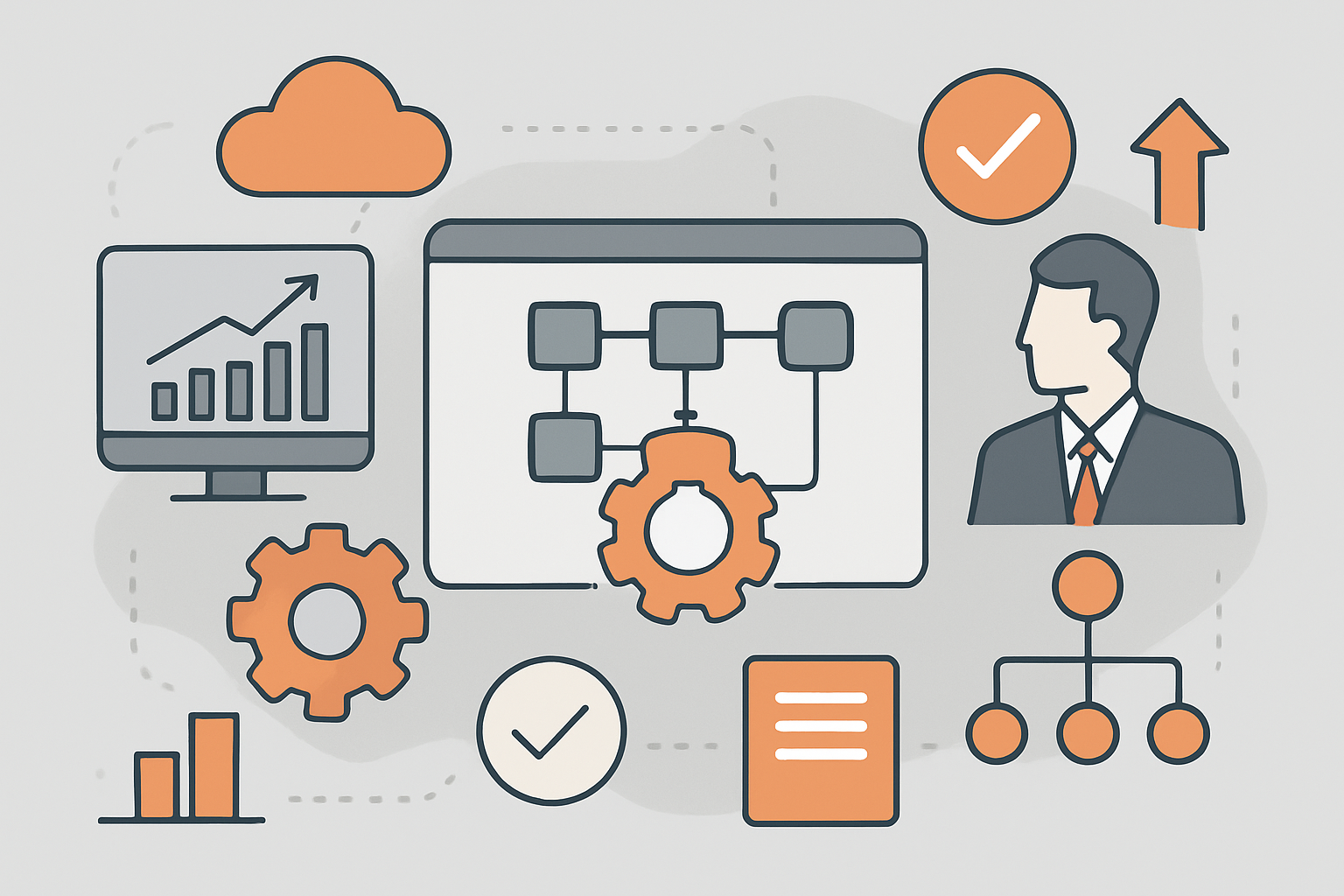
How platform control planes and composable safety pipelines are reshaping enterprise delivery
Enterprise delivery is changing shape. What used to be a pipeline focused mostly on build, test, approval, and release is becoming a broader operating system for governance, automation, and risk control. As AI agents, Kubernetes platforms, and multi-model application stacks move deeper into production, enterprises are learning that scale does not come from model access alone. It comes from a platform control plane that coordinates policies, permissions, evaluations, deployment workflows, and runtime oversight as one system.
For founders and operators building scalable businesses, this matters beyond large IT departments. The same principles behind enterprise platform control planes can inform how companies design repeatable operations, reduce execution risk, and accelerate delivery without losing control. Recent moves from OpenAI, AWS, Netomi, Akuity, and Flux-based enterprise platforms show a clear market direction: enterprise delivery is evolving into a composable safety pipeline where trust, compliance, and operational discipline are built into the path from idea to production.
The shift from tools to control planes
For years, many organizations approached delivery as a collection of tools. One product handled CI/CD, another handled security scanning, another managed infrastructure, and another logged runtime issues. That approach worked when systems were simpler and releases were mostly deterministic. It breaks down when teams need to coordinate cloud environments, Kubernetes clusters, AI services, data permissions, and autonomous agents that can take actions on behalf of users.
This is why platform control planes are gaining importance. A control plane is not just a dashboard. It is the centralized layer that defines policy, orchestrates workflows, standardizes deployment, and provides oversight across distributed systems. In practical terms, it allows a business to scale execution through consistent rules rather than heroic manual intervention. That is a powerful pattern for any enterprise focused on operational efficiency and sustainable growth.
The trend is visible across infrastructure and AI. Akuity’s AWS Marketplace listing describes an enterprise Argo CD platform that extends Kubernetes APIs for application deployment, container orchestration, event automation, and progressive delivery. Its architecture is agent-based, with the cluster connecting to the Argo control plane rather than the reverse. ControlPlane Enterprise for Flux CD is positioned similarly, packaging secure, scalable, multi-tenant Kubernetes delivery with declarative deployment models, release governance, reconciliation workflows, and operational controls. The message is clear: delivery governance is becoming a productized platform capability.
Why AI is pushing governance into runtime
AI is accelerating this shift because the risk profile is different from traditional software. A static application usually behaves within known boundaries if tested properly before release. An AI-enabled system can generate novel outputs, call tools, take actions, and interact with sensitive data in ways that require ongoing supervision. This is why enterprise AI is moving toward governed execution layers rather than simple access to a model endpoint.
Netomi’s production stack offers a useful signal. It uses GPT-4.1 and GPT-5.2 inside a governed orchestration pipeline, reflecting OpenAI’s position that enterprise AI must be trustworthy by design and that governance needs to be woven into runtime. This is a meaningful change in enterprise architecture. Instead of treating safety as a one-time wrapper around a model, companies are embedding evaluation, routing, permissions, and controls directly into the operating layer that manages work.
OpenAI reinforced this direction in its May 2026 enterprise AI reporting, which emphasized the need for systematic evaluation, security, compliance records, and oversight for AI coworkers. That framing matters. It suggests that delivery pipelines are becoming composable safety pipelines, where businesses combine model choices, policy checks, logging, approvals, and human escalation into a repeatable system. For leaders focused on business systems and automation, this is the difference between experimentation and durable operational scale.
Composable safety pipelines are replacing one-off guardrails
One of the biggest enterprise mistakes is relying on isolated guardrails. A prompt filter here, a red-team exercise there, and maybe a compliance checklist before launch can create the illusion of safety without creating a reliable system. As AI and software stacks grow more interconnected, organizations need controls that compose across stages of delivery and operations.
OpenAI’s March 2026 acquisition of Promptfoo points directly to this future. The stated direction was security and safety testing built into the platform, including automated red-teaming for prompt injection, jailbreaks, data leaks, tool misuse, and out-of-policy agent behavior. That matters because it turns testing from an occasional event into an integrated capability. In a scalable business, integrated capabilities outperform ad hoc interventions every time.
A composable safety pipeline means evaluations can be plugged into design, development, staging, deployment, and runtime review. It means policy checks can travel with applications and agents rather than live in separate documents. It also means audit trails, evidence collection, and approval logic become reusable system components. For enterprise teams, this reduces operational drag. For growth-stage businesses, it creates a repeatable path to move faster while preserving control and accountability.
Enterprise adoption is increasingly a controls problem
OpenAI’s June 1, 2026 announcement that frontier models and Codex are generally available on AWS made an important point: enterprises want a faster path from evaluation to deployment without leaving their existing security, governance, procurement, billing, and deployment workflows. That is not only a cloud distribution story. It is a statement about how enterprise adoption actually happens.
In other words, most organizations do not resist AI because they lack access. They hesitate because new capabilities must fit into trusted operating frameworks. If a tool bypasses procurement, weakens compliance posture, creates unclear billing exposure, or introduces unmanaged production risk, it becomes hard to scale no matter how impressive the technology is. This is why OpenAI’s AWS framing explicitly treats enterprise adoption as a controls problem.
For business leaders, the lesson is strategic. New technology scales when it lowers coordination costs across the organization. Platform control planes help do that by connecting innovation to existing systems of approval, governance, and deployment. That is what turns technical capability into business throughput. It also explains why the companies gaining leverage are often not those with the most experiments, but those with the strongest operating model for controlled rollout.
Runtime monitoring is becoming a core delivery function
As agents gain more autonomy, release-time checks are no longer sufficient. A coding agent, support agent, or operational agent may behave appropriately in testing and still take an unexpected action in production. This creates a major shift in delivery design: inspection must continue after deployment, with attention to actions, permissions, policy boundaries, and user intent.
OpenAI’s March 2026 internal monitoring write-up shows how control planes are evolving for agentic systems. It describes a low-latency monitoring system that reviews coding-agent interactions and alerts on actions inconsistent with user intent or policy. That is an important operational pattern. It treats runtime monitoring not as observability alone, but as live governance for AI-driven work.
For enterprises, this means the safety pipeline must continuously inspect what agents are doing, what tools they are invoking, and whether behavior stays inside approved boundaries. For founders and operators, the broader principle is simple: automation must be instrumented where decisions are made, not just checked after outcomes appear. In scalable businesses, operational excellence depends on feedback loops that are immediate, visible, and actionable.
Frontier safety is becoming an operational discipline
OpenAI’s Preparedness Framework update in April 2025 sharpened safeguards around biological and chemical risk, cybersecurity risk, and self-improvement risk. More importantly for enterprise delivery, it emphasized stronger requirements for minimizing risk in practice and clearer operational guidance on how safeguards are evaluated, governed, and disclosed. This reflects a broader market reality: frontier safety is no longer a research-side concern alone.
When operational guidance becomes more explicit, enterprises need systems that can convert policy into execution. That includes evaluation protocols, approval gates, incident response workflows, evidence capture, and disclosure mechanisms. A mature platform control plane makes this possible by turning governance principles into repeatable operating routines instead of informal team knowledge.
This mirrors long-standing cloud governance guidance from AWS, which emphasizes finding and preventing defects early in the software delivery process. The convergence is notable. Traditional software quality, cloud governance, and frontier AI safety are all moving toward the same conclusion: controls work best when embedded early and enforced continuously. That is the foundation of a composable safety pipeline.
Centralized governance with distributed enablement is the winning pattern
OpenAI’s May 2026 enterprise AI report points to a model of centralized governance and training with distributed enablement. This is almost a direct description of how modern platform teams operate. A central function defines standards, policies, approved services, and oversight mechanisms, while individual teams ship work quickly within those boundaries.
That design solves a common scaling problem. If every team builds its own deployment rules, evaluation logic, and safety processes, the business accumulates inconsistency and hidden risk. If everything is centralized in one bottlenecked team, innovation slows down. The control plane model balances both needs. It creates shared guardrails and reusable systems while allowing product, data, engineering, and operations teams to move independently.
OpenAI’s June 2026 analysis of frontier firms adds evidence that this model compounds adoption. Leading organizations are moving from chat-based assistance to delegated agent work, building governance for production use, and scaling what works. OpenAI reports that frontier firms now use 3.5 times as much intelligence per worker as typical firms, up from 2 times in April 2025. That suggests platform-level governance and repeatable pipelines are not administrative over. They are force multipliers for business growth and operational efficiency.
What this means for scalable business systems
Even if your company is not operating at Fortune 500 scale, the direction is relevant. The core lesson is that modern growth does not come from adding more disconnected tools. It comes from designing systems where execution, governance, and measurement reinforce one another. Whether you are shipping software, automating support, or introducing internal AI workflows, a control plane mindset helps you scale without losing visibility.
In practical business terms, that means standardizing the path from idea to production. Define which models, tools, and deployment environments are approved. Create reusable policy checks. Build evaluation into delivery workflows. Log who approved what, which data was accessed, and which actions were taken. Add runtime monitoring for high-risk automations. This is how business automation becomes reliable enough to support revenue systems, customer operations, and strategic decision-making.
It also changes leadership priorities. Instead of asking only, “What can this tool do?” leaders need to ask, “What system will govern how this tool is used at scale?” That question applies equally to AI coworkers, Kubernetes delivery, workflow automation, and operational analytics. In all cases, the businesses that win are the ones that convert complexity into structured operating leverage.
A practical roadmap for founders and operators
Start by identifying where delivery risk currently lives in your organization. In many companies, the weak points are not model quality or developer skill. They are scattered approvals, unclear data handling rules, inconsistent testing, weak audit trails, and limited runtime oversight. OpenAI’s 2026 governance-related policy materials reinforce that weaknesses in data governance, monitoring, and rollout safety protocols are now recognized as core enterprise risks. That should be a signal to mature your operating system, not just your tooling.
Next, build a lightweight control plane approach. For a smaller company, that may be a standardized set of workflows rather than a large platform team. Establish approved services, role-based permissions, deployment templates, review criteria, escalation paths, and logging requirements. If you are adopting AI, define how prompt security, tool permissions, data leakage checks, and behavior evaluations are tested before and after release. The goal is not bureaucracy. The goal is repeatability.
Finally, treat safety and delivery as one design problem. The strongest emerging pattern across Netomi, OpenAI, AWS, Akuity, and Flux-based enterprise platforms is not one model, one app. It is a platform layer that orchestrates models, policies, evaluations, and actions together. For entrepreneurs and small business leaders, that same pattern can drive scalable operations: centralize standards, distribute execution, automate evidence, and monitor continuously. That is how you build a business that can grow faster without becoming fragile.
Platform control planes and composable safety pipelines are reshaping enterprise delivery because they address the real constraint of modern scale: coordinated trust. As AI systems become more capable and software environments more distributed, speed alone is no longer enough. Businesses need a way to move from experimentation to production inside clear operational, security, and governance frameworks.
The strategic takeaway is straightforward. If you want scalable business systems, build for governed execution, not just feature velocity. The organizations setting the pace are combining centralized governance, distributed enablement, continuous monitoring, and reusable safety controls into one operating model. That model will increasingly define how companies achieve operational excellence, sustainable growth, and resilient automation in the years a.
Share this content:




Post Comment