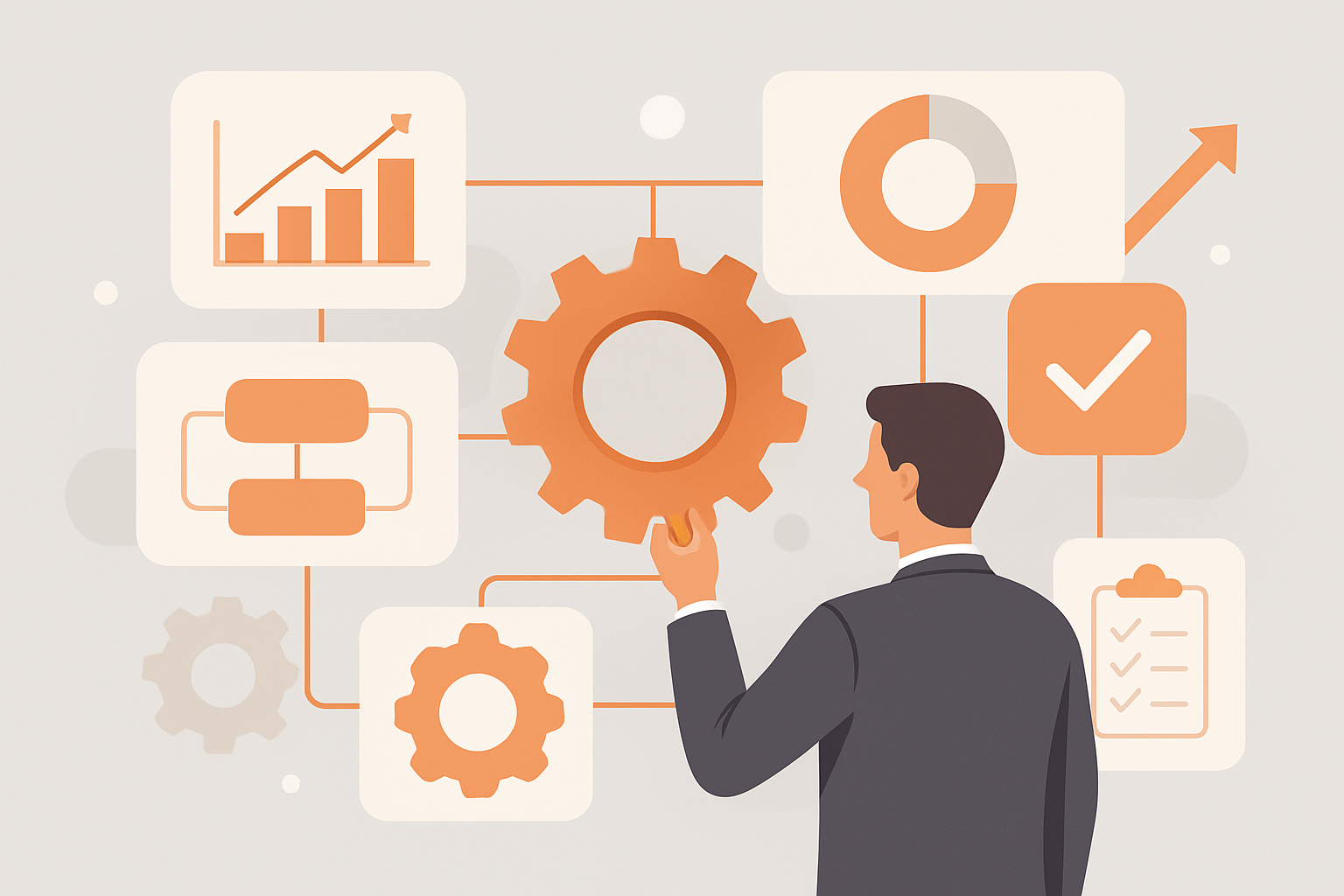
How executives are rewiring core platforms to turn routine work into strategic advantage
In 2026, executives are no longer asking whether AI belongs in the business. They are asking how quickly they can rewire core platforms so AI, automation, and data can reshape how work gets done at scale. Across research from McKinsey, Accenture, IBM, Deloitte, PwC, Microsoft, and Thoughtworks, the signal is consistent: AI is moving from a helpful tool to an operating model that changes capacity, decision-making, and growth potential.
For founders and business leaders, this shift matters because routine work is becoming the raw material for strategic advantage. The companies pulling a are not just modernizing infrastructure or adding isolated automations. They are rebuilding systems, workflows, governance, and talent models so repetitive execution is absorbed by platforms and agents, while people focus on judgment, creativity, exception handling, and expansion.
Why platform rewiring has become a leadership priority
McKinsey’s Global Tech Agenda 2026 shows that top CIOs are rewiring their companies for growth, not merely maintaining technology estates. That distinction is critical. Leaders are moving beyond the idea that core systems exist only to support the business. Increasingly, those systems define how fast the business can learn, adapt, launch, and monetize new opportunities.
This is why infrastructure modernization alone is no longer enough. McKinsey’s framing is blunt: infrastructure modernization is no longer a strategy; it is a stall. In practical terms, replacing servers, upgrading cloud environments, or improving back-end stability may be necessary, but none of that guarantees competitive advantage unless it connects directly to workflow redesign, better decisions, and revenue outcomes.
For small business leaders and growth-focused operators, the lesson is simple: do not confuse technical upkeep with strategic transformation. Rewiring core platforms means redesigning the business engine so that systems, data, and AI work together to reduce friction and create leverage. That is what turns technology spending into a growth asset instead of an over line.
From AI tools to AI operating models
The biggest shift in 2026 is that executives are starting to treat AI as an operating model rather than a software feature. That means AI is being embedded into the way work moves through the company, how decisions are routed, how exceptions are escalated, and how opportunities are surfaced. It is less about adding a chatbot and more about rethinking how the organization functions.
McKinsey reports that AI is now the top technology investment priority, surpassing cybersecurity and infrastructure modernization. At the same time, half of respondents expect technology budgets to rise by more than 4 percent in 2026 compared with 2025. Nearly nine in ten organizations, according to Accenture, plan to increase AI investment, and most see it as a driver of revenue growth. The market is making a clear bet that AI-enabled operating models will shape competitive position.
Microsoft’s 2026 positioning reinforces the same idea. Frontier firms are building AI-ready environments where leaders encourage experimentation and managers actively model AI use. This is not a side initiative managed by one technical team. It is a business-wide shift in behavior, process design, and operating discipline. The firms that get this right will not just use AI better; they will organize differently because of it.
How routine work becomes strategic capacity
One of the clearest business cases for rewiring core platforms is the conversion of repetitive work into usable human capacity. Accenture highlights a financial services firm that mapped work down to the task level and found that moving repetitive data processing to AI agents could unlock up to 30% more human capacity for creativity and judgment. That is not just efficiency. It is a direct reallocation of talent toward higher-value work.
Deloitte describes a similar outcome at the organizational level. As AI absorbs routine execution tasks, structures begin to flatten. Humans spend less time pushing standard work through the system and more time handling exceptions, exercising judgment, and providing strategic oversight. In other words, the organization gains speed not by working harder, but by reducing the amount of low-value coordination work people have to do.
For entrepreneurs and scaling companies, this should change how automation is evaluated. The best question is not just, “How many hours can we save?” A better question is, “What higher-value outcomes become possible when repetitive execution is removed?” Strategic capacity can mean more time for sales, stronger customer relationships, faster product iteration, tighter compliance review, or better forecasting. That is where advantage emerges.
The rise of the platform-first operating model
Thoughtworks reports that one in three organizations are rebuilding for the AI era by shifting toward platform-driven engines that increase agility and reduce technical debt. This reflects a larger move away from one-off transformation projects toward continuous modernization. Rather than waiting for large and risky interventions, companies are designing platforms that can evolve constantly with business demands.
This platform-first approach matters because AI performance depends on the environment around it. If workflows are fragmented, data is trapped in silos, and systems are hard to change, AI will deliver uneven results. By contrast, modular cloud-native architectures, shared services, governed data, and reusable workflow components make it easier to deploy agents, improve processes, and scale successful use cases across departments.
Accenture describes the winning model as an intelligent superhighway. That includes governed data, explicit decision logic, codified workflows, modular architecture, and a future-ready workforce. This is a useful framework for executives because it clarifies that AI advantage does not come from a single model or application. It comes from building an environment where intelligence can move reliably through the business.
Why portability, optionality, and architecture now affect ROI
IBM’s 2026 Tech Leader Study adds an important financial dimension to this conversation. Organizations that preserve workload portability and design for optionality early report 10% higher AI ROI. This finding matters because many firms still treat architecture decisions as technical details, when in reality those decisions shape speed, bargaining power, resilience, and the economics of future AI expansion.
The challenge is that portability remains rare. IBM says only 25% of enterprise workloads are easily portable, which means many businesses are still constrained by rigid platforms and vendor lock-in. When systems are inflexible, every new AI initiative becomes slower, more expensive, and harder to scale. Optionality is not a luxury; it is a strategic hedge that keeps the business adaptable as tools, regulations, and market conditions change.
This is one reason CIOs and CTOs are now becoming shapers of strategy rather than simple enablers. As IBM notes, they are defining what strategies are even possible. For business leaders, that means platform architecture deserves direct executive attention. Decisions about interoperability, APIs, data structure, and portability are no longer buried technical concerns. They are choices that influence growth and long-term competitive freedom.
Breaking silos and building a living AI backbone
PwC’s 2026 Digital Trends in Operations survey finds that more than four-fifths of respondents believe AI agents and automation will accelerate the breakdown of traditional functional silos. That is a major development because routine work often becomes expensive and slow when it gets handed from one team, tool, or department to another. AI orchestration can reduce that friction by allowing work to move across systems more fluidly.
Yet enterprise-wide execution still lags behind ambition. PwC notes that while 97% of energy respondents report having an enterprise-wide AI strategy, only 30% say AI is fully embedded across business units. This gap between strategy and implementation is where many organizations remain stuck. They have the vision, but not the operating model, platform discipline, or governance needed to embed AI consistently.
Deloitte’s description of a living AI backbone helps explain what is required. Executives are under pressure to build real-time, organization-wide systems that adapt dynamically to business and regulatory change. In practical terms, that means data pipelines, decision frameworks, controls, and workflows must be continuously updated rather than periodically reviewed. A living backbone is what allows AI to stay useful as the business changes.
Governance and talent are now part of the same strategy
One of the most overlooked realities of platform rewiring is that technology strategy cannot be separated from people strategy. Accenture reports that only one third of executives say their talent strategy is fully integrated with their AI strategy. That gap creates a predictable problem: companies invest in tools and agents without redesigning roles, incentives, training, and managerial expectations.
Leadership involvement is also proving essential in governance. Deloitte finds that enterprises where senior leadership actively shapes AI governance achieve significantly greater business value than those that leave the work to technical teams alone. That makes sense. Governance determines where AI can act, what it can decide, how risk is monitored, and when humans must intervene. These are strategic decisions, not just compliance tasks.
Microsoft’s guidance aligns with this as well. Organizations need managers who model AI use, create permission to experiment, and reward adoption where it improves outcomes. For smaller companies, this can be an advantage. They often have fewer layers to change, which means founders can move faster in aligning workflows, role design, and accountability. But that only happens when leaders treat AI adoption as an organizational redesign effort, not a software rollout.
What execution looks like for growth-focused businesses
For executives who want to turn routine work into strategic advantage, the first step is to map how work actually happens. Identify repetitive tasks, handoff points, bottlenecks, approval loops, and data dependencies. This mirrors the approach Accenture highlighted: task-level analysis reveals where agents can take over low-value execution and where humans should remain responsible for judgment and exceptions.
The second step is to choose a platform-first path rather than a patchwork of isolated automations. Start with shared data definitions, reliable integrations, explicit workflow rules, and modular systems that can evolve. If AI is added on top of broken processes or fragmented tools, it tends to amplify inconsistency. If it is built into a coherent operating layer, it creates compounding gains.
The third step is to manage modernization as a continuous practice. Thoughtworks emphasizes that competitive firms are moving away from one-time interventions and toward ongoing modernization. That means reviewing workflows regularly, measuring adoption, refining governance, improving portability, and expanding successful automations across functions. Strategic advantage will belong to businesses that keep rewiring, not those that declare transformation finished.
The evidence from 2026 is clear: rewiring core platforms is no longer a technical project at the edge of the business. It is becoming a central leadership task tied to growth, ROI, resilience, and organizational design. When executives treat AI as an operating model, they stop optimizing isolated tasks and start redesigning how value is created across the company.
For entrepreneurs and small business leaders, this creates a practical opportunity. Routine work does not have to remain a permanent drag on growth. With the right combination of governed data, modular systems, AI orchestration, leadership governance, and talent alignment, repetitive execution can be converted into strategic capacity. That is the real promise of AI platform rewiring: not just doing the same work faster, but building a business that can think, adapt, and scale more effectively.
Share this content:





Post Comment