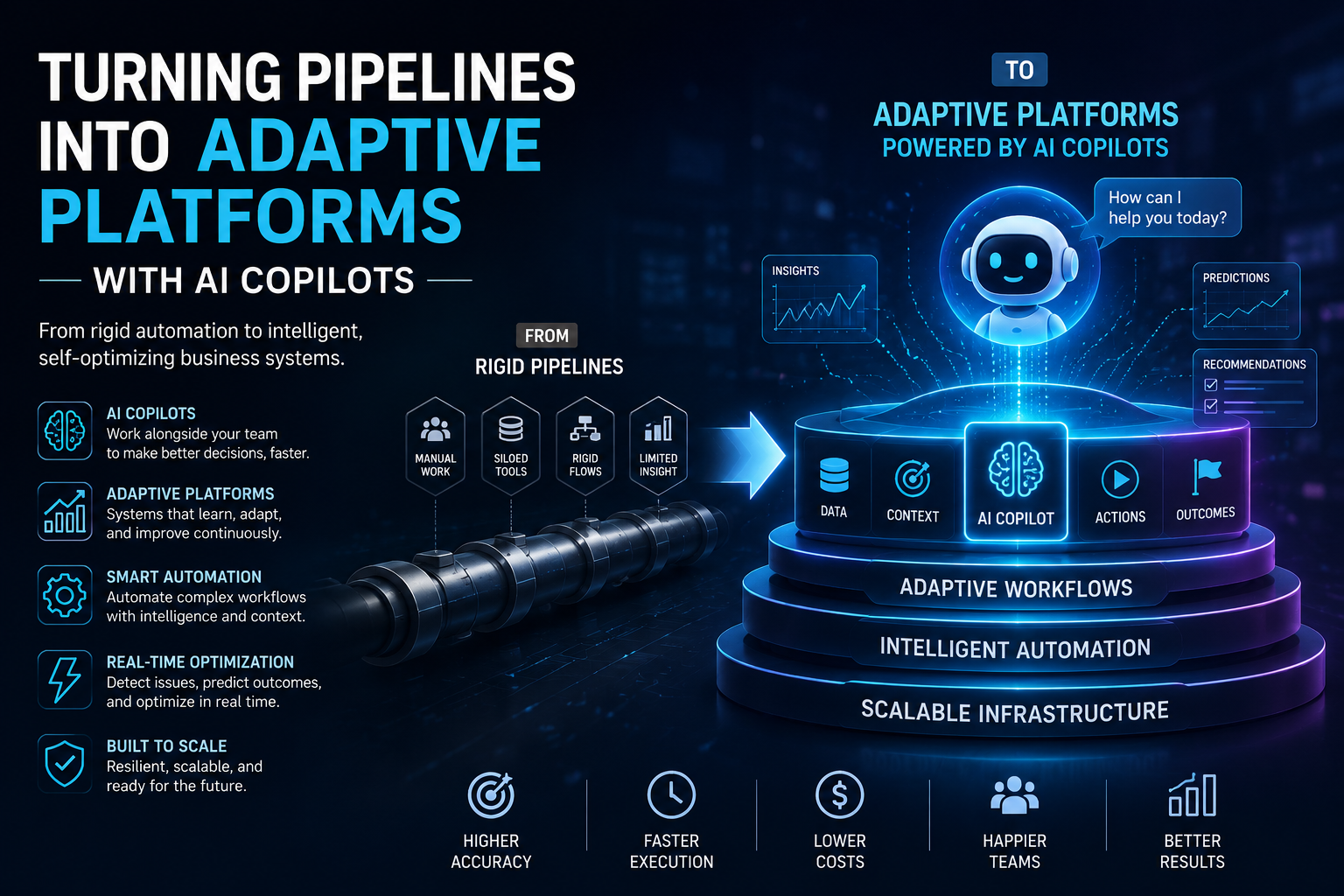
Turning pipelines into adaptive platforms with AI copilots
Most business pipelines were designed to move work from one stage to the next as predictably as possible. That model still matters, but it is no longer enough for companies that want faster decisions, lower operating friction, and better use of AI. The shift happening now is not simply about adding a chatbot to an existing workflow. It is about turning static pipelines into adaptive platforms where AI copilots can monitor context, recommend next actions, trigger automations, and coordinate work across systems.
For entrepreneurs, startup founders, and small business leaders, this change has practical consequences. It affects how you design your operations, how your teams interact with software, and how you scale without multiplying complexity. Recent platform and research signals all point in the same direction: AI copilots are evolving from assistive interfaces into orchestration and control-layer components that can observe, decide, and act across business and technical workflows.
From fixed pipelines to adaptive platforms
A traditional pipeline is built for repeatability. Data enters, a sequence runs, outputs are generated, and the next system picks them up. That structure works well when conditions are stable and exceptions are limited. But modern businesses operate in environments where priorities shift quickly, inputs are messy, and decisions need to happen in real time. In that setting, a fixed pipeline often becomes a bottleneck rather than a growth system.
An adaptive platform goes further than workflow automation. It combines orchestration, decision logic, observability, evaluation, and execution into one operational layer. Instead of only moving tasks forward, it continuously checks whether the task should change, whether the data is valid, whether the model output is trustworthy, and whether a better next step exists. That is what makes the platform adaptive rather than merely automated.
This is increasingly reflected in how vendors describe their products. Dagster now positions itself as “Your platform for AI and data pipelines,” which signals the convergence of data orchestration, machine learning operations, and AI application workflows. For business leaders, that convergence matters because scalable businesses need systems that can support both structured process automation and AI-driven decision support without splitting the stack into disconnected tools.
Why AI copilots are becoming orchestration layers
The biggest misconception about AI copilots is that they are just smarter chat widgets. In reality, the market is moving toward copilots as orchestration layers. OpenAI’s May 27, 2026 profile of Warp describes “Open Agentic Development” as a move away from individual coding assistants and toward systems that coordinate large numbers of persistent agents over time. That is a major conceptual leap. It reframes the copilot from helper to coordinator.
OpenAI has also positioned Codex as a broader agent platform for software engineering. In November 2025, the company described GPT-5.1-Codex-Max as a reliable coding partner trained on agentic tasks across software engineering, math, and research. The implication is clear: copilots are being trained not only to answer prompts, but to manage multi-step work, maintain context, and support execution across a broader operational surface.
That same pattern is highly relevant beyond engineering. In business operations, an AI copilot can become the control plane for routing approvals, watching for anomalies, summarizing status, triggering follow-up actions, and coordinating specialized agents for sales, finance, support, or analytics. When leaders think in systems, the question is no longer “Where can we add AI?” but “Which workflows should AI supervise, optimize, and improve over time?”
Low latency is now a strategic requirement
Adaptive platforms depend on timing as much as intelligence. If an AI copilot takes too long to interpret an event, evaluate context, or return a recommendation, the workflow breaks down. Delay creates friction, forces humans back into manual work, and limits the system’s ability to operate in a closed loop. That is why low-latency model serving is no longer a technical luxury. It is a platform requirement.
OpenAI’s February 12, 2026 launch notes for Codex-Spark highlight this clearly. The team said it had to reduce latency across the full request-response pipeline and built a dedicated low-latency serving tier to support real-time collaboration. This matters because adaptive platforms are not just running isolated model calls. They are supporting interactive, iterative, and often multi-agent workflows where every extra second compounds operational drag.
For founders and operators, the business lesson is straightforward. If your AI layer cannot respond fast enough to support daily execution, it will be sidelined. In customer support, revenue operations, engineering workflows, or internal reporting, speed determines whether a copilot becomes part of the operating system or remains a novelty. Real scalability requires systems that can sense, think, and act at business speed.
Observability, validation, and evaluation are the new foundation
As pipelines become adaptive, visibility becomes non-negotiable. A platform cannot safely make decisions if you cannot see what data came in, how the model processed it, what output was produced, and whether the result was useful. That is why modern platform design increasingly emphasizes validation, freshness checks, automated testing, and observability as built-in capabilities rather than afterthoughts.
Dagster’s cloud platform specifically highlights validation, automated testing, freshness checks, and observability to keep pipeline data consistent and accurate. That is exactly the kind of infrastructure adaptive businesses need. If your metrics are stale, your input data is corrupt, or your copilot acts on outdated assumptions, automation becomes risk rather than leverage. Operational efficiency depends on trustworthy system behavior.
This requirement has also created a distinct category around AI observability. OpenLayer defines it as tracking and diagnosing input data, model logic, and outputs in production, including multimodal pipelines and AI agents. Comet’s Opik extends the pattern with open-source observability and evaluation workflows bundled into the platform itself. In practical terms, this means leaders need to treat AI quality assurance like core infrastructure, not an optional analytics layer.
Closed-loop feedback is what makes a platform adaptive
The technical pattern emerging across orchestration, low-latency inference, observability, and evaluation points to one central idea: adaptive platforms require closed-loop feedback. A copilot must do more than generate an answer. It needs to observe what happened after the answer, compare outcomes against expectations, and adjust future recommendations or actions accordingly. Without that loop, the system is still assistive, not adaptive.
This is where many companies fall short. A 2025 journal article on ArtifactOps and ArtifactDL argues that most software solutions still wrap a model into an API instead of managing the full pipeline. That shortcut may produce a demo, but it rarely produces a durable operating system. Businesses save real time and reduce repetitive work when the full AI lifecycle is automated through integrated DataOps and MLOps practices.
For a scalable business, closed-loop design means connecting inputs, decisions, outputs, monitoring, and remediation. It also means deciding what the copilot is allowed to do autonomously and what still requires human approval. The platform becomes stronger over time because it is constantly learning from results. That is how systems thinking translates AI into operational excellence instead of one-off experimentation.
How natural-language copilots are changing platform workflows
One of the most important shifts in platform design is the embedding of copilots directly inside operational tools. Instead of forcing users to learn complicated query languages, dashboard structures, or command syntax, modern platforms increasingly let people express intent in plain language. The copilot then translates that intent into a validated action inside the system.
Dagster’s Compass is a strong example. It allows analysts to turn plain-language questions into optimized SQL queries. That sounds simple, but the strategic value is larger than convenience. It lowers the skill barrier between business questions and system actions, which means companies can move faster without overloading technical specialists. In a scalable business, reducing dependency on bottleneck roles is a major advantage.
The same principle is appearing in other domains. Research on “Pipelines with Copilot and Adaptive Sequences” shows that copilots are changing workflows outside coding, including adaptive sales sequences. For founders and small business leaders, this opens a clear path: use AI copilots to bridge the gap between human intent and platform execution across sales, support, reporting, and process management. That is how automation becomes more accessible and more useful.
What research says about agentic pipelines and autonomous teammates
Academic and industry research is increasingly documenting the rise of autonomous software-engineering teammates and agentic workflows. A 2025 arXiv study examined more than 456,000 pull requests across five agents, including OpenAI Codex and GitHub Copilot, to analyze how autonomous teammates function in development environments. That scale matters because it shows these systems are no longer theoretical experiments.
A January 2026 arXiv paper goes further by framing the transition as a shift toward “agentic pipelines.” It argues that embedded software engineering teams are rethinking workflows, roles, and toolchains to support generative AI-augmented development. Another 2025 study on adaptive AI in software development bots traces the evolution from simple query systems to more advanced adaptive tools. Together, these findings reinforce the idea that pipelines are becoming dynamic systems with AI-driven participation.
Business leaders should pay attention even if they are not running engineering teams. Software development often previews broader operational change. What starts in dev tools tends to spread into revenue operations, finance automation, service delivery, and business intelligence. The same architecture that supports autonomous teammates in code can eventually support adaptive systems in the rest of the company.
How to build an adaptive platform roadmap for your business
The most effective approach is not to rebuild your company around AI overnight. Start by identifying one pipeline where delays, handoff failures, or repetitive decisions are clearly hurting growth. Good candidates include lead routing, sales follow-up, onboarding, internal reporting, support triage, or product delivery workflows. Then map the current process end to end, including data sources, decision points, approvals, and failure modes.
Next, define where an AI copilot can create leverage. In some cases, that means summarizing context and recommending a next step. In others, it means translating natural language into queries, monitoring pipeline health, drafting actions for approval, or coordinating automations across systems. The best opportunities usually sit at the intersection of high frequency, high friction, and clear economic value. That is where operational efficiency and business growth align.
Finally, build the governance layer as seriously as the AI layer. Include validation, freshness checks, observability, evaluation metrics, fallback rules, and escalation paths. Vendors like Opsera are already marketing AI copilots for end-to-end DevOps automation with governance and orchestration features, and the observability market is moving toward AI-native workloads and autonomous remediation. The practical takeaway is simple: if you want a scalable business system, you must design for both intelligent action and accountable control.
Turning pipelines into adaptive platforms with AI copilots is not just a technology trend. It is a strategic operating model for companies that want to scale with more precision and less friction. The businesses that benefit most will be the ones that treat AI as part of the system architecture, not as a layer of convenience on top of broken processes.
For entrepreneurs and founders, the opportunity is significant. Build platforms that can observe, evaluate, decide, and improve continuously, and you create a stronger foundation for sustainable growth. In the next phase of automation, competitive advantage will come from systems that do not merely process work, but actively help the business think, adapt, and execute better over time.
————————–****———————————————————————————————————————-
The companies that survive long term build:
✔ Structured business systems
✔ Automated workflows
✔ Operational processes
✔ Financial visibility
✔ Scalable infrastructure
If you are building a business and planning to grow, this article explains why rapid expansion destroys so many companies — and how to build a scalable automated business that lasts.
📖 Read the full article:
For entrepreneurs who want to go deeper into automation, financial systems, and scalable business architecture:
📘 The Automated Wealth System
https://ebooks.invexsales.com/b/the-automated-wealth-system-how-to-eliminate-financial-blind-spots-automate-your-business-and-build-continuous-income-even-if-you-re-starting-from-scratch
📘 AUTOMATE YOUR BUSINESS IN 7 DAYS (NO CODING)
https://ebooks.invexsales.com/b/automate-your-business-in-7-days-no-coding-build-a-system-that-runs-without-you
📘 The 7 Financial Blind Spots That Keep Entrepreneurs Broke
https://ebooks.invexsales.com/b/the-7-financial-blind-spots-that-keep-entrepreneurs-broke-and-why-you-must-automate-your-business-to-build-real-wealth
📘 THE ARCHITECT’S BLUEPRINT
https://ebooks.invexsales.com/b/the-architect-s-blueprint-build-the-system-that-pays-you-even-when-you-re-not-working
The future belongs to businesses built on systems, not stress.
#BusinessSystems #BusinessAutomation #Entrepreneurship #ScalableBusiness #StartupGrowth #BusinessGrowth #Automation #DigitalBusiness #OperationsManagement #InvexSales
Share this content:






Post Comment