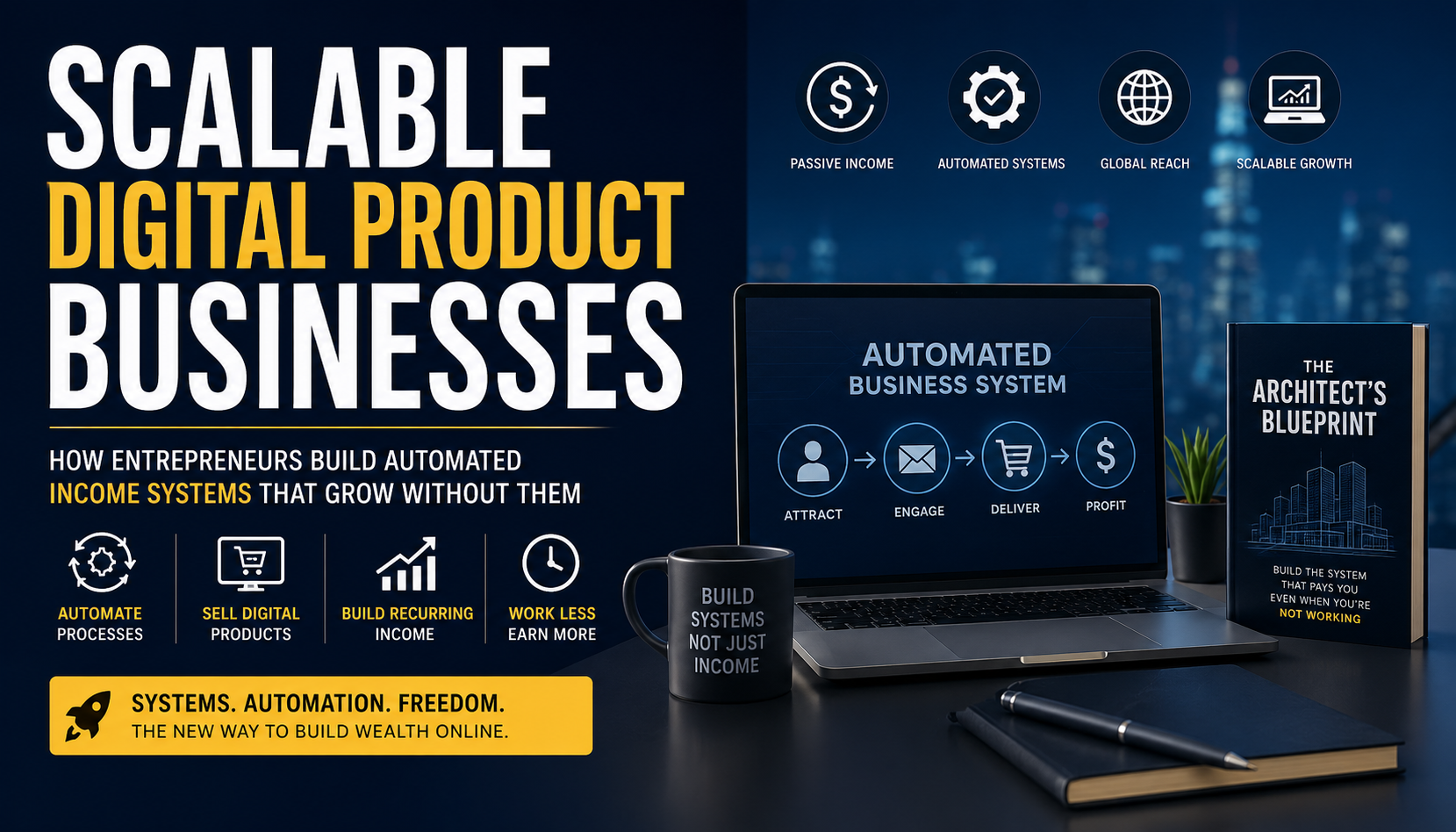
Scalable Digital Product Businesses: How Entrepreneurs Build Automated Income Systems That Grow Without Them
Introduction: Why Digital Product Businesses Are Dominating the Modern Economy
Over the last decade, the business landscape has changed dramatically. Traditional brick-and-mortar businesses often require significant inventory, large in-person teams, expensive physical locations, and ongoing operational complexity that eats into profit margins. In contrast, digital product businesses have emerged as one of the most scalable, resilient, and profitable business models ever created in human history.
Today, entrepreneurs can build businesses that sell products around the clock, serve customers across multiple time zones, and generate substantial revenue without the logistical limitations associated with physical operations. Whether it is an ebook, an online course, a digital template, software-as-a-service, membership content, consulting framework, or knowledge product, digital assets have fundamentally changed how wealth can be created in the twenty-first century.
What makes digital product businesses particularly attractive is their inherent scalability. Unlike traditional businesses where growth often requires proportional increases in resources such as labor, real estate, and raw materials, digital products can be created once and sold thousands or even millions of times with minimal additional cost. This one-to-many economic model represents a paradigm shift in how entrepreneurs think about value creation and income generation.
This is why many of today’s fastest-growing entrepreneurs focus on building systems rather than simply selling products. They understand that the product itself is only half the equation. The other half is the automated infrastructure that delivers, supports, and markets that product without requiring constant human intervention.
The real question is no longer: “How can I work harder?” The question successful entrepreneurs ask is: “How can I build a system that works without me?” That single shift in thinking is what separates self-employed individuals who own a job from true business architects who own an asset. When you internalize this distinction, everything about how you build, operate, and scale your business begins to change for the better.
What Is a Scalable Digital Product Business?
A scalable digital product business is a company that generates recurring or transactional revenue by selling digital assets that can be delivered automatically, updated efficiently, and distributed globally without significant additional costs per customer. Unlike service-based models where you trade time for money, a scalable digital product business allows you to decouple your effort from your income.
Examples of scalable digital products include ebooks that teach specialized skills, online courses with video modules and downloadable resources, business templates for marketing funnels or financial models, software applications that solve specific problems, membership communities with premium content, digital reports and industry analyses, AI prompts that improve productivity, standard operating procedures for business operations, financial planning frameworks for retirement or investing, and complete business systems documentation.
The defining characteristic of a scalable digital product business is leverage. Leverage is an economic concept that refers to accomplishing more output with less input. When a restaurant serves one hundred additional customers, it must buy more ingredients, employ more kitchen staff, hire more servers, and potentially expand its physical space. When an ebook sells one hundred additional copies on Amazon or Gumroad, the delivery costs remain virtually unchanged, and no new human labor is required to fulfill those orders.
This creates a powerful economic advantage that compounds over time. The entrepreneur invests effort upfront to create value, designs a seamless delivery mechanism, and then builds automated marketing and support systems that distribute that value repeatedly without friction. The result is a business capable of growing far beyond the founder’s available time, energy, and attention. That is the holy grail of modern entrepreneurship.
Why Most Entrepreneurs Fail to Build Scalable Businesses
Many entrepreneurs mistakenly believe that revenue automatically creates wealth and that higher sales numbers inevitably lead to financial freedom. In reality, many business owners generate impressive sales while remaining trapped inside daily operations, unable to take a vacation, launch a new initiative, or even sleep through the night without checking their email.
They become the salesperson, customer support representative, marketing manager, operations manager, accountant, project coordinator, and IT department all rolled into one exhausted human being. The business depends entirely on them for every major decision and every minor task. This creates what many experts call the founder dependency problem, and it is the single biggest obstacle to scalability.
When the founder stops working, growth slows immediately. When the founder becomes unavailable due to illness or emergency, operations begin to suffer within days. When the founder takes a vacation, revenue often declines noticeably. This is not scalability. This is employment disguised as entrepreneurship, and it leads to burnout, frustration, and ultimately business failure at alarming rates.
One of the biggest causes of this problem is the absence of documented systems. Businesses fail to scale because processes remain trapped inside the founder’s head rather than being written down, automated, and delegated to software or team members. Without clear systems, every task becomes an exception, every customer request requires a custom response, and every operational decision requires founder approval. This bottleneck prevents growth and destroys quality of life.
For entrepreneurs seeking to understand this challenge more deeply, the ebook “The Architect’s Blueprint: Build the System That Pays You — Even When You’re Not Working” explains how successful founders design businesses that operate independently of their daily involvement. It provides a step-by-step framework for transitioning from hands-on operator to strategic business architect who profits from systems rather than hours.
The Four Pillars of a Scalable Digital Product Business
Every scalable digital business is built on four core pillars that work together to create a resilient, automated, and profitable operation. If any of these pillars is weak or missing, the entire structure becomes unstable, and growth will eventually stall or reverse.
Pillar 1: Valuable Intellectual Property
Digital products begin with knowledge, expertise, and unique insights that cannot be easily replicated by competitors. The most successful digital entrepreneurs package their specialized expertise into repeatable solutions that solve real problems for specific audiences. This intellectual property may include financial frameworks for retirement planning, marketing systems for ecommerce stores, business operating procedures for remote teams, productivity methodologies for creative professionals, or industry-specific knowledge that has been refined through years of experience.
The goal is not merely to provide information. The goal is to solve painful problems and deliver measurable outcomes. Customers purchase outcomes, not content. They do not buy a course on Facebook ads because they want to watch videos. They buy the course because they want more customers, more sales, and more profit. Your intellectual property must be positioned as the bridge between their current frustration and their desired transformation.
Pillar 2: Automated Distribution
A scalable business must be capable of delivering value automatically, without manual intervention from the founder or support team. Modern software platforms make it possible to process payments, deliver products, manage customer access, send onboarding email sequences, collect customer feedback, and even issue refunds, all without human involvement. This automation transforms a static product into a living system that operates twenty-four hours per day, seven days per week, three hundred sixty-five days per year.
This is why many founders focus on building automated sales infrastructure before attempting to scale traffic. Without automation, more traffic means more manual work, more errors, and more frustration. With automation, more traffic simply means more revenue without additional operational burden.
Entrepreneurs interested in implementing practical automation strategies can explore “Automate Your Business in 7 Days (No Coding): Build a System That Runs Without You.” This guide explains how business owners can begin automating core operations like email delivery, customer onboarding, payment processing, and basic support without technical expertise or programming knowledge. It focuses on accessible tools and step-by-step workflows that produce immediate results.
Pillar 3: Predictable Customer Acquisition
Many businesses fail not because their products are poor but because sales arrive randomly and unpredictably. Scalable companies reject randomness and instead create repeatable customer acquisition systems that generate leads and conversions on autopilot. Examples include search engine optimization that attracts organic traffic from Google, content marketing that builds authority and trust, email marketing that nurtures relationships over time, referral systems that incentivize word-of-mouth growth, strategic partnerships that expand reach, and automated sales funnels that convert visitors into buyers without human sales calls.
Rather than constantly searching for customers like a hunter chasing prey, scalable businesses build systems that attract customers continuously like a farmer cultivating crops. This shift from hunting to farming creates predictability, and predictability creates stability, and stability enables confident growth investments. When you know exactly how much it costs to acquire a customer and exactly how many customers your system will generate next month, you can scale with precision rather than guesswork.
Pillar 4: Financial Visibility
Many entrepreneurs operate without a clear understanding of their financial reality. They know their top-line revenue and their basic expenses, but they do not understand profit leakage from inefficient processes, cash flow inefficiencies caused by delayed payments, hidden costs buried in software subscriptions they no longer use, revenue concentration risks where a single customer represents too much income, or operational inefficiencies that waste time and money daily.
These blind spots often prevent growth because entrepreneurs cannot make intelligent decisions without accurate data. In many cases, businesses do not fail because they lack sales. They fail because they lack financial visibility. They run out of cash despite having revenue because they do not see where money is disappearing. They lose profitable customers because they do not track satisfaction metrics. They invest in the wrong marketing channels because they do not measure customer acquisition cost properly.
The ebook “The 7 Financial Blind Spots That Keep Entrepreneurs Broke — And Why You Must Automate Your Business to Build Real Wealth” provides a practical framework for identifying the hidden financial issues that quietly undermine business growth. It shows entrepreneurs how to implement simple tracking systems that reveal the truth about their profitability and create a foundation for sustainable scaling.
Why Automation Is the Real Engine of Scalability
Many entrepreneurs assume scalability means increasing sales, and they focus all their energy on marketing and conversion optimization. Sales growth is certainly important. However, growth without corresponding automation often creates operational chaos that destroys value rather than creating it.
As customer volume increases, support requests increase exponentially because more customers mean more questions, more confusion, and more edge cases. Administrative work increases because more orders mean more invoices, more refunds, and more data entry. Reporting requirements increase because investors, partners, and tax authorities demand more information. Operational complexity increases because more products mean more inventory, more delivery paths, and more potential failure points.
Without automation, growth can actually reduce profitability as you hire more support staff, spend more time on administrative tasks, and deal with more customer complaints about slow service. This is why modern digital businesses prioritize systems before scaling traffic. They automate first, then scale. This sequence ensures that growth improves profitability rather than destroying it.
Automation enables entrepreneurs to serve more customers without hiring proportional staff, reduce operational costs by eliminating manual busywork, improve customer experience through faster response times and consistent quality, increase consistency by removing human error from routine tasks, and scale efficiently without exponential cost increases. Businesses that automate effectively create leverage, and leverage is the foundation of wealth creation.
Instead of exchanging hours for dollars in a straight trade, entrepreneurs create systems that generate value continuously whether they are working, sleeping, or traveling. This concept is explored extensively in “The Automated Wealth System: How to Eliminate Financial Blind Spots, Automate Your Business, and Build Continuous Income — Even If You’re Starting From Scratch.” The book demonstrates how automation, financial visibility, and business systems work together to create long-term wealth rather than temporary income.
The Psychology of Letting Go: Why Founders Struggle with Automation
Even when entrepreneurs understand the benefits of automation intellectually, many struggle to implement it emotionally. There is a psychological barrier that prevents founders from handing over control to software systems and documented processes. This barrier is rooted in fear, perfectionism, and identity.
Fear tells you that no system can handle customer requests as well as you can. Perfectionism insists that every email, every support ticket, and every delivery must be customized perfectly for each customer. Identity confusion makes you believe that being a hands-on problem solver is what makes you an entrepreneur, and that stepping back means losing your purpose.
These psychological obstacles are often harder to overcome than technical challenges. You can learn to use email automation software in an afternoon. Learning to trust that software with your reputation and revenue can take months or years. Yet this trust is essential for scalability. As long as you insist on controlling every interaction, you remain the bottleneck. As soon as you build systems you can trust, you become free to focus on strategy, innovation, and growth.
How to Choose Your First Digital Product for Maximum Scalability
If you are new to digital products, choosing where to start can feel overwhelming. The key is to begin with a product that balances ease of creation with market demand and scalability potential. Many first-time creators make the mistake of building a massive online course with dozens of videos before validating whether anyone will buy it. This approach leads to wasted time and crushed spirits.
A better approach is to start small with a low-risk product like a short ebook, a template, a checklist, or a mini-course. These products can be created in days rather than months, allowing you to test your market, refine your offer, and generate initial revenue quickly. Once you have proven demand, you can expand your product line with more comprehensive offerings for the same audience.
When evaluating potential product ideas, ask yourself three questions. First, do I have unique expertise in this area that others would pay to access? Second, is there a specific problem I can solve that customers are already searching for solutions to? Third, can this product be delivered entirely through automation without ongoing manual involvement? If you answer yes to all three questions, you have found a viable scalable digital product opportunity.
The Role of Customer Feedback in System Improvement
Automation does not mean building a system and forgetting about it forever. The best digital product entrepreneurs treat their automated systems as living entities that require continuous improvement based on customer feedback. They build feedback loops into their automation so that every support ticket, every refund request, and every customer review becomes data that drives system enhancements.
For example, if customers frequently ask the same question in your support email, that question should be added to your FAQ page or answered in an automated email sequence. If customers struggle to complete your checkout process, that friction point should be identified and eliminated through better design. If customers request a feature your product does not have, that request becomes a candidate for your next product update or new product launch.
This cycle of feedback and improvement is what separates average digital products from exceptional ones. The average product is created once and never updated. The exceptional product evolves continuously based on real customer needs, becoming more valuable, more automated, and more profitable over time.
Avoiding Common Automation Mistakes That Destroy Customer Trust
While automation is powerful, it must be implemented thoughtfully to avoid damaging customer trust. Some entrepreneurs automate so aggressively that customers feel like they are interacting with a robot rather than a human business. This leads to frustration, refund requests, and negative reviews that can destroy your reputation.
The key is strategic automation. Automate routine, predictable, low-emotion tasks like delivery receipts, password resets, and basic FAQ answers. Keep humans involved for complex, high-emotion situations like refund disputes, technical problems, and customer complaints. Use automation to enhance human interaction rather than replace it entirely.
Another common mistake is failing to test automated systems thoroughly before launching. A broken automated email sequence that sends the wrong message or no message at all creates a terrible customer experience. Always test your automation from the customer’s perspective, using different email addresses, payment methods, and scenarios to identify hidden bugs before real customers encounter them.
From Solopreneur to Automated Enterprise: The Growth Path
The journey from solo founder to automated digital enterprise typically follows a predictable path. In stage one, you create your first digital product and deliver it manually to early customers, learning what works and what does not. In stage two, you automate delivery and basic support while still handling marketing and strategy personally. In stage three, you automate customer acquisition through content marketing, email sequences, and paid advertising systems. In stage four, you automate financial management, reporting, and advanced support through integrated software tools.
Each stage requires different skills and tools, but the underlying principle remains constant: remove yourself from routine tasks so you can focus on high-value activities that actually grow the business. The goal is not to eliminate work entirely but to eliminate the kind of repetitive, low-leverage work that keeps you stuck.
Measuring What Matters: Key Metrics for Scalable Digital Businesses
To manage a scalable digital business effectively, you must track metrics that reveal the health of your automated systems. Revenue alone is not enough. You need to know your customer acquisition cost, or how much you spend to gain each new customer. You need to know your customer lifetime value, or how much revenue an average customer generates over their entire relationship with you. You need to know your conversion rate at each stage of your funnel, from visitor to lead to customer. You need to know your refund rate, support ticket volume, and customer satisfaction score.
These metrics tell you whether your systems are working or failing. A rising customer acquisition cost suggests your marketing automation is becoming less efficient. A falling refund rate suggests your product and delivery automation are improving. A stable support ticket volume despite rising sales suggests your self-service automation is effective. Without these metrics, you are flying blind, reacting to problems rather than preventing them.
Conclusion: Your First Step Toward Building an Automated Digital Empire
The shift from hands-on operator to automated business architect does not happen overnight. It happens through a series of deliberate decisions, each moving you further from day-to-day firefighting and closer to strategic system design. The first step is simply recognizing that your current way of working is not sustainable if your goal is true scalability and freedom.
Look at your business today. What tasks do you perform repeatedly? What questions do you answer over and over? What processes still live only in your head? Each of these represents an opportunity for automation. Document the process. Choose a tool to handle it. Test the system. Then move to the next bottleneck.
The entrepreneurs who dominate the digital economy over the next decade will not be the hardest workers. They will be the best system builders. They will understand that products create revenue, but systems create wealth. They will build businesses that grow without them, freeing their time for what matters most: family, health, creativity, and the next big idea.
Your journey to scalable digital business success starts today. Pick one process to automate. Choose one product to digitize. Measure one metric that matters. Take that first step, and the path ahead will become clearer with each system you build.
–
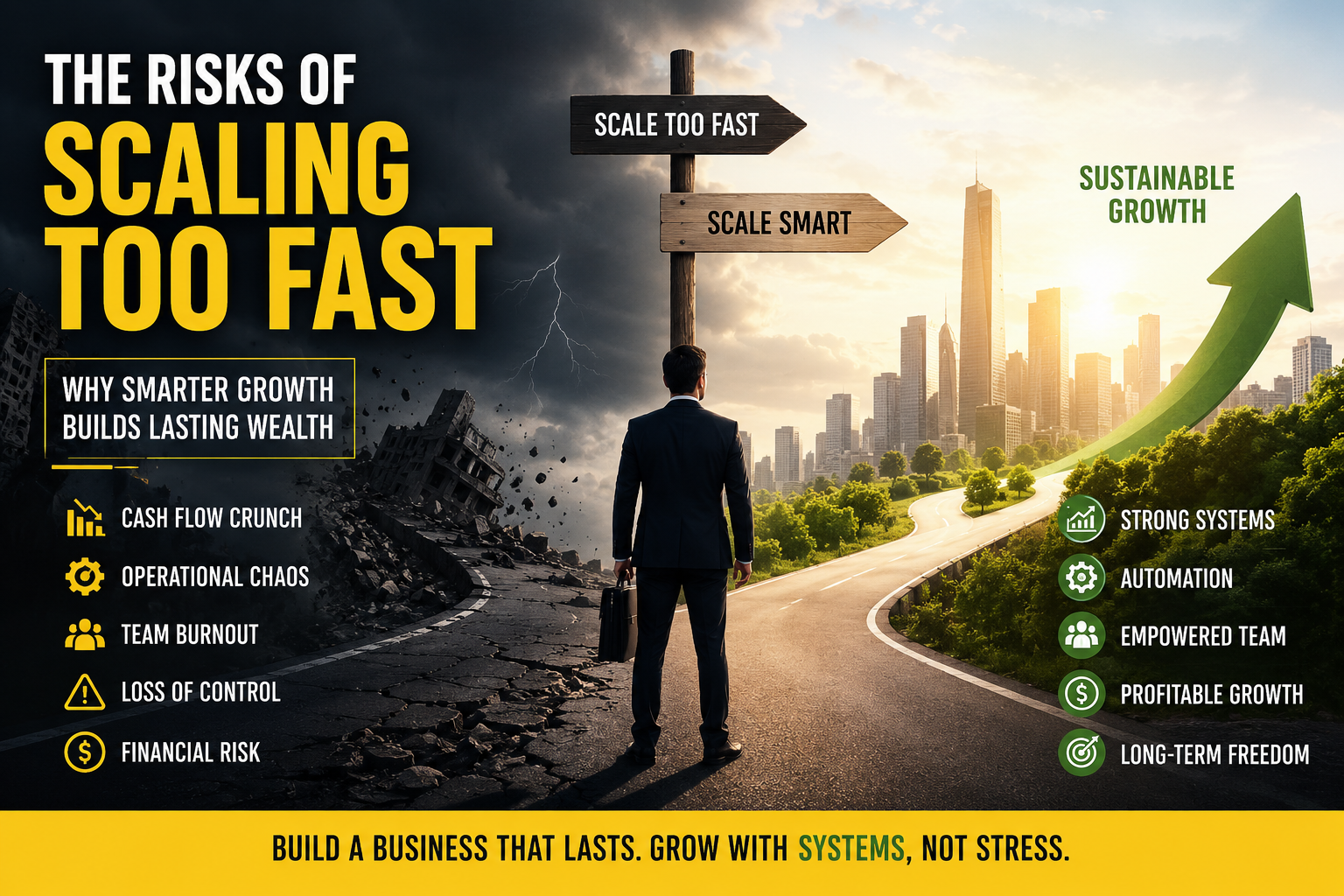
If you are building a business and planning to grow, this article explains why rapid expansion destroys so many companies — and how to build a scalable automated business that lasts.
📖 Read the full article:
For entrepreneurs who want to go deeper into automation, financial systems, and scalable business architecture:
📘 The Automated Wealth System
https://ebooks.invexsales.com/b/the-automated-wealth-system-how-to-eliminate-financial-blind-spots-automate-your-business-and-build-continuous-income-even-if-you-re-starting-from-scratch
📘 AUTOMATE YOUR BUSINESS IN 7 DAYS (NO CODING)
https://ebooks.invexsales.com/b/automate-your-business-in-7-days-no-coding-build-a-system-that-runs-without-you
📘 The 7 Financial Blind Spots That Keep Entrepreneurs Broke
https://ebooks.invexsales.com/b/the-7-financial-blind-spots-that-keep-entrepreneurs-broke-and-why-you-must-automate-your-business-to-build-real-wealth
📘 THE ARCHITECT’S BLUEPRINT
https://ebooks.invexsales.com/b/the-architect-s-blueprint-build-the-system-that-pays-you-even-when-you-re-not-working
The future belongs to businesses built on systems, not stress.
#BusinessSystems #BusinessAutomation #Entrepreneurship #ScalableBusiness #StartupGrowth #BusinessGrowth #Automation #DigitalBusiness #OperationsManagement #InvexSales
Share this content:




Post Comment